Podcast for Business: 5 Ways Experts Win Clients With a Show

A podcast for business does five jobs, from warming up prospects to earning search traffic. See what to track for each, written for coaches and experts.
When a coach, consultant, or founder asks whether a podcast for business is worth the effort, the real question is whether it will bring in clients. A well-run show does bring in clients, though rarely in the way people expect. Most of the business comes from the people the show introduces you to and from prospects who arrive at a sales call already familiar with how you work.
We have produced more than 5,000 episodes for entrepreneurs, experts, and thought leaders, and the shows that pay off for their hosts share a pattern. The host decides early which business result the show is for, picks guests with that result in mind, and publishes on a schedule they can keep for years. The shows that stall usually skip the first step and start measuring downloads instead.
This guide covers the five jobs a business podcast does, what to track for each one, how to set a show up for growth, and what it costs in time and money.
What a podcast for business does
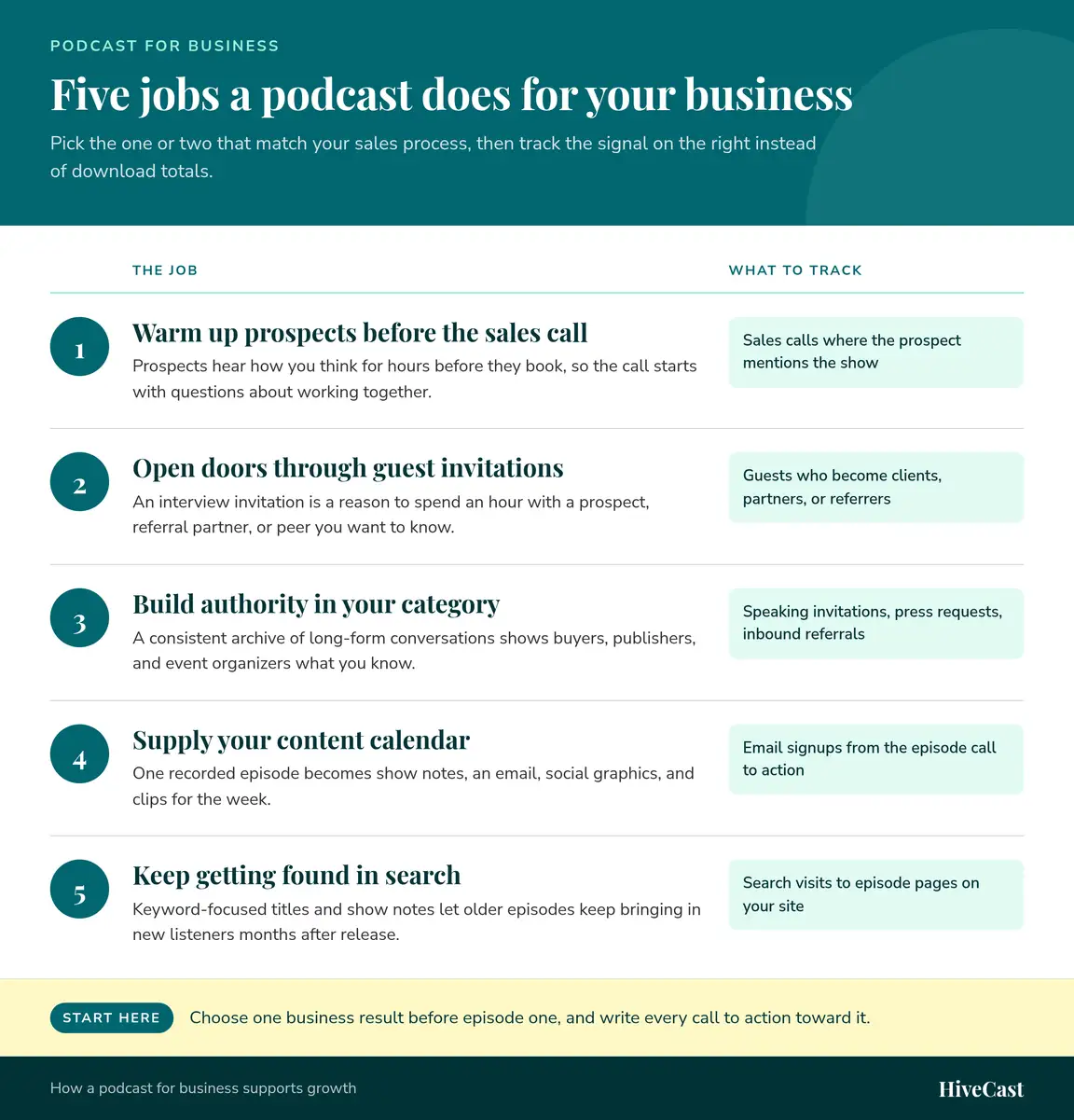
A business show earns its place on your calendar by doing one or more of five jobs. Most hosts only need one or two of them, and the right pair depends on how you sell. A consultant with a long sales cycle cares most about warming up prospects, while an author building toward a book launch cares most about authority. The matrix below pairs each job with the signal that tells you it is working, which is a better measure than a download total.
1. Warm up prospects before the sales call
A prospect who has heard three or four episodes has spent hours listening to how you think. By the time they book a call, they already understand your approach, and the conversation moves to scope and fit instead of credentials. Hilary Silver, who hosts the Ready For Love Podcast, put it this way: “The show has changed my sales conversations completely. The moment a prospect says they’ve been listening, I know they’re going to say yes.”
This is the job that shortens the sales cycle. It works best when episodes answer the questions your prospects ask before they buy, and when you mention the show in your follow-up emails so new leads have a reason to listen.
What to track: how many sales calls include a prospect who mentions the show. Add “How did you hear about us?” to your booking form and ask it on the call.
2. Open doors through guest invitations
An interview invitation is one of the few reasons a busy person will give you an uninterrupted hour. If you choose guests from the list of people you want to know, such as prospective clients, referral partners, and peers who serve the same market, every recording session is also a business development meeting.
Dr. Andrew Fix of The Physio Room, host of The Code: A Guide to Health & Human Performance, describes the same effect: “Over 200 episodes in, The Code has become one of our strongest sources of new clients and referral relationships in the health and performance community.”
What to track: guests who later become clients, partners, or referral sources. Keep a simple list and review it every quarter.
3. Build authority in your category
A consistent archive of long-form conversations shows buyers, publishers, and event organizers what you know in a way a LinkedIn post cannot. For authors, it is proof of an engaged audience ready to buy, which publishers want to see. For thought leaders, it is a way to own the conversation in a niche before a competitor does. Our piece on long-form podcasting covers why the longer format carries more weight than short posts.
What to track: speaking invitations, press requests, and inbound referrals that cite the show.
4. Supply your content calendar
One recorded episode can become show notes, an email to your list, two or three social graphics, and short clips. For a busy expert, that means a single hour of recording supplies a week of marketing, and each piece points back to a longer conversation where the prospect can hear more.
What to track: email signups that come from the call to action in each episode and its show notes.
5. Keep getting found in search
Episode titles, descriptions, and show notes written around the terms your buyers search let older episodes keep bringing in new listeners months after release. This is the job most shows neglect, because it depends on work that happens after the recording, and it is the focus of our podcast SEO service.
What to track: search visits to episode pages on your website, and which episodes bring them in.
💡 Focus on one or two
Most shows only need one or two of these five jobs working at once. Track the signal that matches how you sell instead of trying to cover all five.
Does a business podcast need a big audience?
A business podcast does not need a big audience, because it is judged by who listens, and a small audience of the right people is often worth more than a large general one. A consultant who needs ten new clients a year does not need 50,000 downloads an episode. They need a few hundred listeners who fit the client profile and a clear next step for those listeners to take.
This is also why the “How much does a podcast with 5,000 listeners make?” question misses the point for most of our clients. Sponsorship income depends on audience size. The revenue a business show produces comes from client work, so one new retainer from a listener can outweigh a year of ad revenue.
People also listen to learn, which suits an expert’s show. In a Pew Research Center survey, half or more of Americans who had listened to a podcast in the past year named learning as a major reason they listen, alongside entertainment and having something to listen to while doing something else. An episode that teaches your prospect something useful is the kind of episode they are looking for.
How to set up a podcast for business growth
Most shows that fail to bring in business were set up without a clear purpose, so the setup decisions matter more than the equipment. Our podcast strategy work starts with the five decisions below, in this order, because each one shapes the next.
Pick one business result
Decide what the show is for before you record anything. Common choices are booked discovery calls, a larger email list, referral relationships, or credibility ahead of a book or product launch. One primary result keeps every later choice consistent.
Define the listener
Describe the person you want listening in the same terms you would use for your ideal client: their role, their problem, and what they would search for. Topics, guests, and episode titles all come from this description.
Choose a format you can sustain
Interview shows are the most common format for a business podcast because guests bring relationships and new perspectives. Solo episodes work well for teaching your method and take less coordination. Many of our clients mix the two, with interviews most weeks and a solo episode when there is something specific to teach.
Set a cadence you will keep
A bi-weekly show that publishes for three years does more for a business than a weekly show that stops after four months. Choose the schedule you can hold through busy seasons, then build a small bank of recorded episodes before launch.
Write a call to action for every episode
Each episode should end with one specific next step that serves the business result you picked: a lead magnet, a newsletter signup, or a link to book a call. Keep it the same across episodes so listeners learn where to go.
If you are starting from scratch, our guide to launching a business podcast covers the launch steps in more detail, and the strategy library in our Resources section has more on each of these decisions.
🔴 Choose a schedule you can keep
A schedule you can keep for years does more for a show than a more frequent one that stalls after a few months. Pick the cadence you can hold through busy seasons.
How to measure podcast ROI
Podcast ROI for a business is measured in client work, so the useful metrics are the ones that connect the show to your pipeline. Downloads tell you whether the show is reaching people. The signals below tell you whether it is doing its job.
| Signal | Where to find it | Which job it measures |
|---|---|---|
| Prospects who mention the show | Booking form question, sales call notes | Warming up prospects |
| Guests who become clients or referrers | A guest list you review each quarter | Guest invitations |
| Email signups from episode calls to action | Your email platform, using a dedicated link per show | Content calendar |
| Search visits to episode pages | Website analytics | Search |
| Speaking and press invitations | Your inbox | Authority |
Review these every quarter rather than every week, because a business show builds results slowly. If the numbers stay flat after six months of consistent publishing, the problem is usually the call to action or the guest list, and both can be fixed. Our podcast coaching program, the six-week Business Results Accelerator with founder Sarah Lockwood, is built for hosts in exactly that position.
Is it too late to start a podcast in 2026?
It is not too late, and podcast listening in the United States reached a record high this year. According to Edison Research’s Infinite Dial 2026 study, 58% of Americans aged 12 and older, about 167 million people, consumed a podcast in the last month, and 45% did so in the last week. Among 35 to 54-year-olds, the age group where many business owners and decision-makers sit, monthly listening reached 68%.
There are more shows competing for attention than there were five years ago, but a podcast for business does not need to compete with entertainment shows. It needs to be the best show for a specific listener in a specific niche, and most niches still have room for a consistent, well-produced show.
What a business podcast costs in time and money
The cost of running a podcast for business is mostly time. Recording is the part the host has to do. Editing, show notes, graphics, and publishing are the parts that can be handed off, and they are also where most shows stall, because they take several hours per episode and compete with client work.
There are three common ways to handle production:
- Do it yourself. The lowest cash cost and the highest time cost. It works until your calendar fills up, which for a busy expert is usually a few months in.
- Hire freelancers. Cheaper per episode than an agency, but you manage the editor, the writer, and the designer yourself, and the schedule depends on each of them.
- Use a done-for-you production team. One monthly fee covers the whole workflow, and a dedicated account manager keeps the schedule.
Our podcast production service is the third option. You record and send us the file, and our team handles editing, SEO show notes, two promotional graphics per episode, and scheduling to Apple Podcasts, Spotify, and all the major directories, with a five business day turnaround. The bi-weekly plan is $500 a month and the weekly plan is $875 a month, with no long-term contracts. New shows pay a one-time $495 setup fee, and video editing is a paid add-on at $100 or $200 a month. Full details are on our pricing page.
Getting your business podcast working for you
A podcast helps a business when it has a clear job and a schedule the host can keep. Start with one of the five jobs, track the signal that goes with it, and give the show at least six months of consistent publishing before you judge it. Most hosts find the relationships with guests pay off first, and the effect on sales calls follows as the archive grows.
Our team produces shows for coaches, consultants, authors, and medical professionals every week, so we can tell you quickly which setup fits your business. Book a free discovery call and we will talk through your goals and the plan that suits your schedule.
Frequently Asked Questions About Starting a Podcast for Business
How much does it cost to run a podcast for business?
Doing it yourself costs mostly time: editing, show notes, graphics, and publishing usually take several hours per episode on top of recording. HiveCast's done-for-you plans are $500 a month for an episode every other week and $875 a month for a weekly episode, with editing, SEO show notes, two promotional graphics per episode, and publishing included. New shows pay a one-time $495 setup fee, and video editing is a paid add-on at $100 or $200 a month.
How much of my time does a business podcast take each week?
With done-for-you production, your part is preparing for the conversation, recording it, and approving the drafts, which for most of our clients is about the length of the episode plus some preparation. You record and send us the file, and our team handles editing, show notes, graphics, and scheduling, with a five business day turnaround.
Do I need a large audience for a podcast to help my business?
No. A business show is judged by who listens, not how many. A coach who needs ten new clients a year can get real value from a few hundred listeners who fit the profile, especially when guests are chosen from the people the host wants to build relationships with.
How long does it take before a podcast brings in business?
Guest relationships can start producing results from the first few interviews, because the conversation itself is the introduction. Signals from listeners, such as prospects mentioning the show on sales calls, usually take longer and depend on publishing consistently for several months so the archive has depth.
Am I locked into a long-term contract with HiveCast?
No. HiveCast plans run month to month with no long-term contracts, so you can cancel at any time. Many of our clients start on the bi-weekly plan and move to weekly once the show is part of their sales process.
What happens on a free discovery call?
We talk through your business, who you want to reach, and what you want the show to do, whether you are starting from scratch or already publishing. If you have a show, we listen to a recent episode first. You leave with a recommendation on format and cadence, with no pressure to sign up on the call.
Want this handled for you?
You record the episode, and HiveCast handles the editing, show notes, graphics, and scheduling. We have produced more than 5,000 episodes, and there are no long-term contracts.
More on Podcast Strategy
Related Articles

How to Turn Podcast Clips Into Leads With ManyChat
Learn how to use ManyChat podcast clips and turn Instagram engagement into leads with automated DMs, smarter CTAs, and a better podcast funnel.
Spotify’s New Play Count: What the 30-Second Rule Means
Spotify now counts a play only after 30 seconds. Here is why your numbers may drop, what the new creator analytics show, and how to respond.

Start a Business Podcast: Build Authority and Growth
Start a business podcast with proven strategies. Build authority, grow your brand, and generate leads. Launch your show in 30 days with HiveCast.fm.