How to Book Podcast Guests Who Show Up Ready to Record

Book podcast guests who fit your listeners and show up prepared, with a pitch email template and a follow-up and reminder plan for coaches and experts.
Getting podcast guests to say yes is only the first step of a guest episode. The harder part is everything after the yes: the guest who goes quiet for two weeks, the recording that gets moved three times, and the expert who joins from a noisy café with no idea what the episode is about. Each of those costs you a release slot or an episode you are not happy to publish.
Most advice on booking guests stops at the pitch. This post covers the whole process, from choosing the right people and writing a pitch that gets a reply to the confirmation and reminder emails that get guests to the recording on time and prepared. You will get a scoring table for your shortlist, a fill-in pitch email template, a six-stage booking pipeline with the timing for each step, and a table of the most common reasons guests cancel. Our team has produced more than 5,000 episodes for coaches, consultants, authors and other experts, and this is the process we walk clients through when they add guests to a show.
Why guest episodes are worth the booking work
Guest episodes take more effort than solo episodes, so it helps to know what you are getting for that effort before you build a booking routine. For a business show, a well-chosen guest does three things that are hard to get any other way.
- They bring their audience. A guest who shares the episode puts your show in front of people who already trust them.
- They build relationships. An hour of focused conversation with a potential referral partner or client often does more than months of networking.
- They add authority. Recording with respected people in your field shows prospects who you work alongside.
That is why guest strategy comes up so often in our podcast coaching work. The audience is there to reach, too. Edison Research’s Infinite Dial 2026 survey found that 58% of Americans aged 12 and older listened to a podcast in the last month, about 167 million people. Many of the experts you want on your show are trying to reach their own clients in that audience.
How to find podcast guests who fit your listeners
The quickest way to find podcast guests is to start from the episode you want to make, not from a list of famous names. Write down the question your listeners need answered, then look for the people who can answer it well. This keeps your shortlist tied to your audience, which is what makes a guest say yes and what makes the episode useful once it is out.
Where to look for guests
Aim for a shortlist of 10 to 15 names for each topic, so a few declines do not stall the episode. These sources produce the best fits for business shows:
- Your own clients and partners. They know your audience, they are easy to reach, and their stories make strong episodes.
- People your clients already follow. Ask clients whose newsletters, books or posts they read.
- Conference and webinar speaker lists. Speakers have prepared material and are used to talking to an audience.
- Authors of recent books in your field. Authors want to promote a new book, so they are often the easiest well-known guests to book.
- Active posters on LinkedIn. Someone who writes thoughtful posts every week usually has opinions worth recording.
- Listeners who write in. A listener who emails a smart question may have the expertise for a full episode.
- Guests on similar shows. Someone who did well on a related podcast has already shown they can hold a conversation.
How to score your shortlist
Before you write a single pitch, score each name. It takes a few minutes per guest and saves you from booking someone who turns out to be a poor fit for your listeners.
| What to check | How to check it | Warning sign |
|---|---|---|
| Audience fit | Do the people they serve overlap with your listeners? | Their audience would never buy what you sell |
| A clear point of view | Read two or three recent posts or articles | Everything they publish is generic advice |
| Speaking ability | Watch a talk, a video or a past podcast appearance | Long, rambling answers with no examples |
| Willingness to share | Do they post links to their other interviews? | They have never shared an appearance |
| Reachability | Is there an email address or a mutual contact? | The only route is a cold message to a busy inbox |
Rank the names, then pitch the top three or four first. If your first choices decline, the next names are already waiting, and you do not have to start the search again.
Podcast guest outreach that gets a reply
Good podcast guest outreach is short and specific. The guest should be able to decide from one email whether the episode is worth an hour of their time. A long pitch that lists your download numbers and your life story gets skimmed and left for later, which in practice means it never gets answered.
What a guest needs to know before saying yes
A guest weighs four things, so your pitch should answer each one in a sentence or two:
- Why them. Name a specific post, talk or idea of theirs. This shows you are not sending the same email to fifty people.
- The topic. Propose one clear episode angle they can picture themselves talking about.
- Who listens. Describe your audience in a sentence, such as “founders of service businesses with five to twenty staff”.
- The commitment. Give the length of the recording, the format, and how the episode will be promoted.
Keep the whole message under 150 words. If they want more detail, they will ask.
A podcast guest pitch template you can adapt
Replace the bracketed parts and rewrite the opening line in your own words for each guest. Guests can tell when a pitch is a copied template, so the first two lines should be about them.
Pitch email template
Subject: Guest invitation: [episode topic] on [show name]
Hi [first name],
Your post on [specific idea from their work] changed how I explain [related topic] to my clients, and I would like to give my listeners the full version.
I host [show name], a podcast for [one-sentence description of your audience]. I would love to have you on for an episode about [proposed angle], with a focus on [one or two specific questions].
The recording takes about 45 minutes on a remote recording platform, and I will send the topics a week ahead. The episode goes out on [release month] with show notes, a link to your website, and graphics you can share.
Would you be open to it? If so, here is my calendar link: [link].
Thanks,
[your name]
Subject lines and where to send the pitch
Your subject line should say what the email is, because a vague subject looks like spam. “Guest invitation: pricing a coaching offer” does that, and “Quick question” does not. Email is the best channel for a first pitch, since it gives the guest room to read and forward it to an assistant. A warm introduction from someone you both know is better still. Use social media messages to make contact first, then ask for the best email address for a short proposal.
The six-stage podcast booking pipeline
Once guests start replying, you need a simple process so nobody slips through. We use the six stages below with clients, and the timing beside each one is what we recommend for a weekly or bi-weekly show.
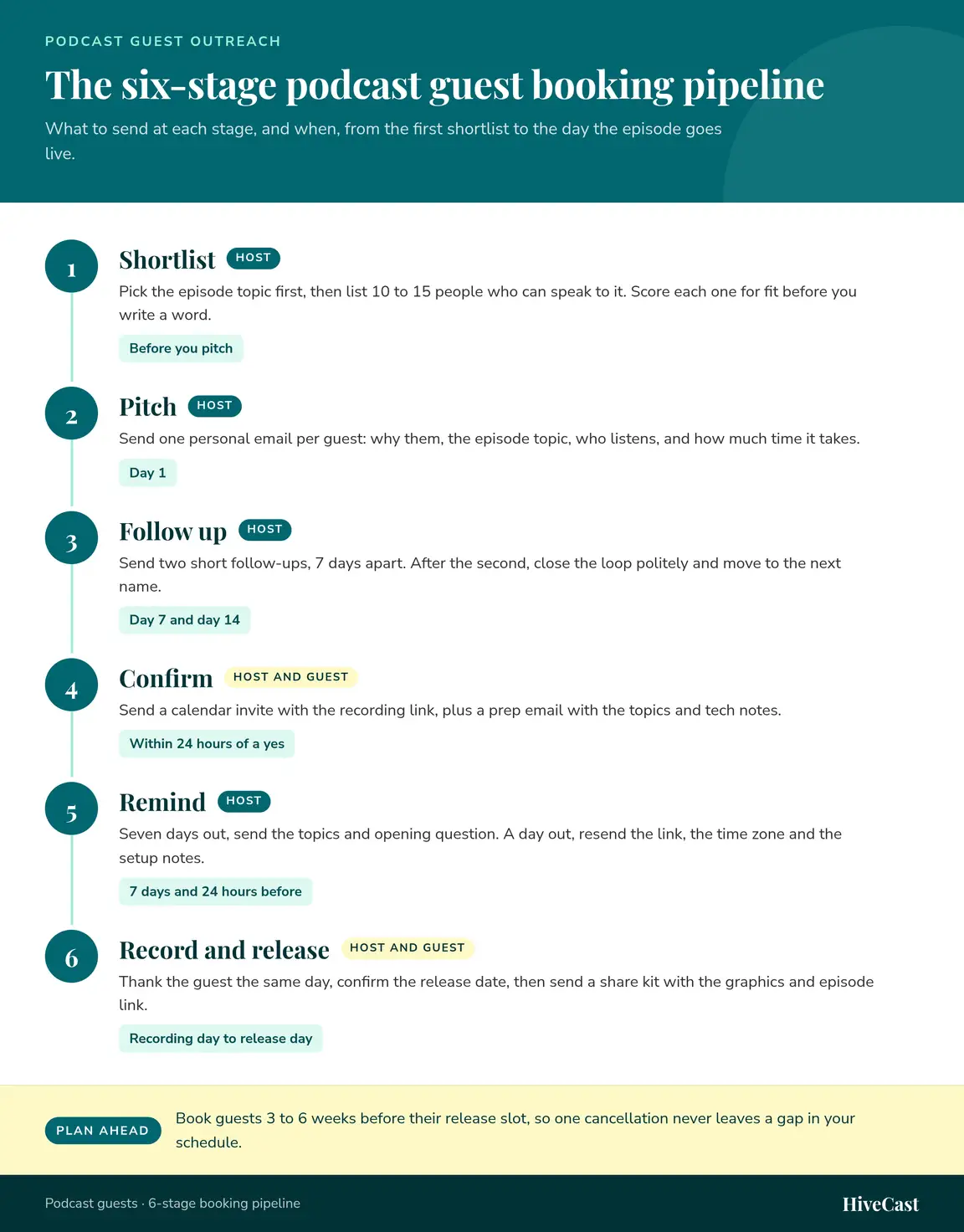
Track every guest in a simple spreadsheet with a column for each stage and the date you last contacted them. A shared sheet also makes it easy to hand the follow-ups to an assistant.
Follow-up timing
A guest who does not reply to a pitch is often busy rather than uninterested. Send the first follow-up on day 7 and the second on day 14, each shorter than the one before. Add something new to each follow-up, such as a second topic idea or a recent episode they might like. If the second follow-up gets no answer, send a final note saying you will not chase further and the offer stays open, then move to the next name on your shortlist.
The confirmation email
When a guest says yes, reply within 24 hours while the episode is still on their mind. Send a calendar invite that includes the recording link, the time zone, and how long to block out, plus a short prep email with the topics. If they have an assistant, copy them in.
The reminder schedule
Send two reminders. Seven days before the recording, send the topics and the first question you plan to ask, so the guest can think about their answers. Twenty-four hours before, resend the recording link, confirm the time zone, and repeat the setup notes. That second message is the one that catches a forgotten appointment or a poor recording location before it costs you the session.
How to stop podcast guests canceling or not showing up
In our experience, guests usually cancel because the recording slipped down their list of priorities between the yes and the date. The table below lists the causes we see most often and what to do about each one.
| Why guests cancel or no-show | What prevents it |
|---|---|
| The recording was booked months ahead | Book 3 to 6 weeks out, not three months |
| The invite never reached their calendar | Send a calendar invite, not only an email with a time |
| They confused the time zone | Write the time in their time zone in the invite title |
| They forgot what the episode was about | Send the topics 7 days before |
| The link or setup confused them | Resend the link and setup notes 24 hours before |
| An assistant controls their calendar | Copy the assistant on the confirmation |
Even with all of this in place, some guests will cancel. Keep one finished solo episode or a replay with a new intro ready, so a late cancellation does not leave a gap in your release schedule. Our post on solo episodes covers how to make those just as strong as your interviews.
💡 Rebook within two weeks
When a guest cancels, offer two specific new times within the next two weeks in your first reply. An open-ended “let me know when works” usually leads to nothing being booked.
Prepare your guest for a good recording
A guest who knows what to expect gives better answers and needs less editing. The prep email you send with the confirmation should cover:
- The format. Episode length, whether it is audio only or also recorded on video, and how the conversation will run.
- The topics. Three or four themes and your opening question, not a full script.
- The setup. A link to the remote recording platform, a request for headphones and a wired internet connection if possible, and a quiet room with soft furnishings.
- Their links. Ask which website, offer or social profile they want mentioned in the show notes.
On the day, a few minutes of casual conversation before you start recording helps the guest relax. For the interview itself, our post on interview strategies covers question flow, follow-ups and steering a guest back on topic. If your guests tend to be specialists, our guide to expert interviews explains how to draw out answers your listeners will remember.
What to send your guest after the recording
What you send after the recording decides whether the guest shares the episode and whether they would come back.
- A thank-you on the same day. Keep it short and mention one thing from the conversation you found useful.
- The release date. Give a specific date. When the episode is professionally produced, you can plan it from the turnaround time. Our team returns episodes within five business days of receiving the audio, so you can confirm a date before the recording ends.
- A share kit on release day. Send the episode link, a two-sentence description they can paste, and the promotional graphics. Every HiveCast episode includes two graphics, such as an episode announcement and a quote card.
- A follow-up a month later. Share how the episode performed, or a listener comment that mentioned them.
A ready-made share kit means the guest does not have to write their own post, which makes it far easier for them to share the episode with their audience. Our post on professional networking explains how a guest relationship can turn into referrals once the episode is out.
Paid guest spots and disclosure
Some hosts charge guests to appear, and some guests offer to pay. Either arrangement changes what you owe your listeners. The FTC’s Endorsement Guides say that a payment, a free product, or another incentive should be disclosed when it could affect how much weight the audience gives to what is said. In practice, if a guest paid to be on the show or earns a commission on something they recommend, say so on the episode and in the show notes. We advise most business shows to avoid paid guest spots altogether, because a paid appearance needs that disclosure on every episode and changes how listeners hear the guest’s advice.
Common podcast guest booking mistakes
These are the mistakes we see most often when hosts start booking podcast guests, and each one is avoided by the process above.
- Pitching famous names first. Start with guests one step ahead of you, and use those episodes as samples for bigger pitches.
- Sending the same pitch to everyone. A pitch without a specific reason for choosing that guest reads like a mass email.
- Following up too often, or never. Two follow-ups, a week apart, is enough.
- Booking too far ahead. A recording three months away is easy to cancel.
- Skipping the reminders. The 24-hour reminder is your best chance to catch a forgotten booking.
- No backup episode. One cancellation should not mean a missed week.
- Going quiet after the recording. A guest who never hears about the release date will not share the episode.
Running a guest pipeline every month
Set aside an hour at the start of each month to shortlist and pitch podcast guests for the episodes six weeks out, and keep the spreadsheet from the booking pipeline up to date as replies come in. That one routine keeps your guest episodes booked ahead of their release slots.
The booking and the conversation are the parts only you can do. Our podcast production service handles the rest: editing, show notes, two promotional graphics per episode, and scheduling to Apple Podcasts, Spotify and all the major directories, with every episode back in five business days. Plans are $500 a month for a bi-weekly show and $875 a month for a weekly show, with no long-term contracts. Book a free discovery call and we will help you plan your next run of guest episodes.
Frequently Asked Questions About Booking Podcast Guests
How far in advance should I book podcast guests?
We recommend booking three to six weeks before the guest's release slot. That leaves time to send a prep email, reschedule once if you need to, and still have the edited episode back before the release date. In our experience, booking much further ahead than two months raises the chance of a cancellation, because the guest's calendar changes after they say yes.
Should I pay podcast guests, or charge them to appear?
We recommend neither for most business shows. The guest gets an audience and a finished episode to share, and you get their expertise. If money does change hands in either direction, or a guest gets an affiliate commission on something they mention, tell your listeners on the episode. The FTC's endorsement guidance treats a paid relationship as something the audience should know about.
How many follow-up emails can I send before it becomes pushy?
Two. Send the first follow-up seven days after the pitch and the second seven days after that, each one shorter than the last. If there is still no reply, send one closing note saying you will not follow up again and the invitation stays open. Some guests reply to that last message.
What should I do if a guest cancels on the day of the recording?
Reply warmly, offer two new times within the next two weeks, and keep their release slot filled with a solo episode or a replay you have ready. Do not argue about the cancellation or send a long message. Guests remember how you handled it, and a gracious reply makes them more likely to rebook.
Does HiveCast find and book podcast guests for me?
No. HiveCast does not run guest outreach or booking. We help you plan the mix of guest and solo episodes during onboarding, our Business Results Accelerator covers your content calendar, and once you record, our team edits the episode, writes the show notes, and designs two promotional graphics your guest can share, all within five business days.
Do I need a big audience before I can book good guests?
No. Guests say yes when your listeners match the people they want to reach, and a pitch that names that audience clearly matters more than download numbers. Start with guests one step ahead of you, such as clients, partners and peers, and use those episodes as samples when you pitch better-known names.
What happens on a free discovery call with HiveCast?
We ask about your show, how often you publish, how you use guest episodes, and the clients you want to reach. Then we explain how our production plans work, what they cost ($500 a month for bi-weekly episodes or $875 a month for weekly), and whether coaching would help with your guest strategy. The call is free, there is no obligation, and our plans have no long-term contracts.
Want this handled for you?
You record the episode, and HiveCast handles the editing, show notes, graphics, and scheduling. We have produced more than 5,000 episodes, and there are no long-term contracts.
More on Podcast Coaching
Related Articles
Your Podcast Pilot Blueprint: A Step-by-Step Plan
Do not skip the pilot. A step-by-step guide to planning, recording, and refining your podcast pilot episode before you commit to going live.

How to Be a Better Podcast Host: 7 Interview Tips
Seven interview strategies for podcast hosts, covering guest selection, prep, question design, and staying in control of the conversation on air.

Why to Record Solo Podcast Episodes (And Make Them Good)
Solo episodes build trust, authority, and conversions. Learn why they work, and how to make yours focused, engaging, and worth listening to.