Professional Podcast Editing: 4 Options Before You Hire

Compare 4 professional podcast editing options, from DIY and AI tools to a freelancer or production team, plus 7 questions busy experts should ask first.
Most people who search for professional podcast editing already know their episodes need work. What they are really deciding is who should do that work: themselves, a piece of software, a freelancer, or a production team. Each option handles a different share of the job, and the price you see up front rarely tells you which parts are left for you.
We have produced more than 5,000 episodes and launched 100’s of shows, and many of the hosts who come to us have tried one or two of the other routes first. Their reasons for switching tend to be practical: editing eats their evenings, a freelancer goes quiet for two weeks, or an AI tool leaves in a tangent that a person would cut.
This guide compares the four options on what each one actually handles. It also covers when paying for editing makes sense, what an editor needs from you to do good work, the questions to ask before you hire, and what your first month with a professional editor should look like.
What professional podcast editing adds to a software pass
Software can clean a recording. It removes background hum, balances levels, and trims long silences, and it does that in minutes. What it cannot do is listen to your episode the way a listener will and decide what should stay.
That listening is the core of professional podcast editing. A person plays the episode from start to finish and cuts the tangent that never lands, the story you already told on an earlier episode, and the answer that started before the question finished. Then they listen to the finished file again before it ships. We walk through each stage of that pass in our guide to podcast audio editing, so this post stays on the buying side: which option gets you that listen, and what each one costs you in time.
Four ways to get professional podcast editing, compared
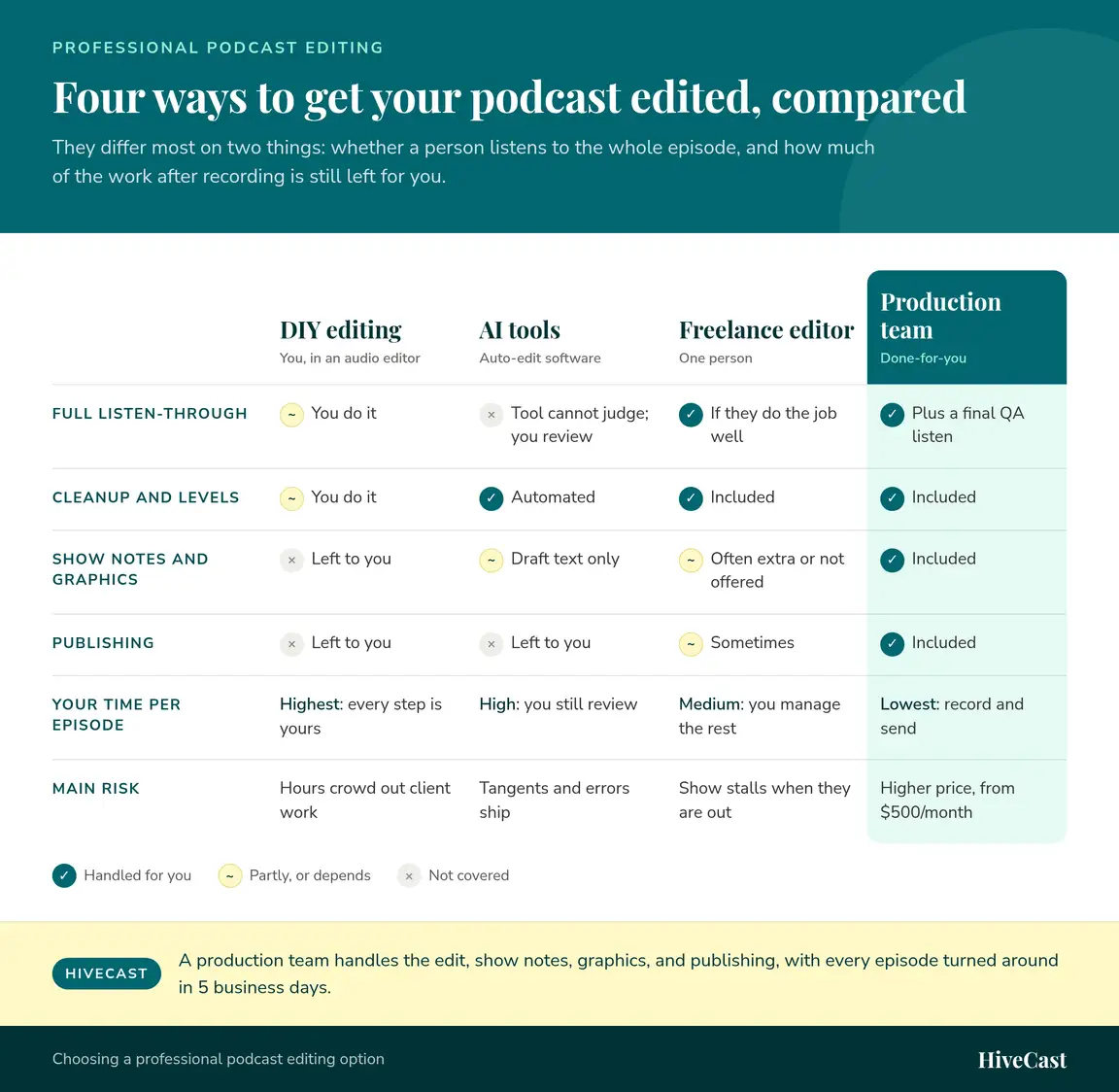
There are four realistic ways to get a show edited. They sit on a line from “you do everything” to “you record and send the file”, and the chart below lays out what each one covers.
DIY in an audio editor
Editing your own show in a digital audio workstation, the category of software that includes tools like Audacity, Adobe Audition, and Hindenburg, costs little or nothing in fees. It costs a lot in hours. You are the one listening to the full episode, making the cuts, leveling the voices, adding the intro and outro, exporting the file, writing the show notes, and uploading it.
DIY works well in two situations:
- You are still testing the format. For the first handful of episodes, editing your own recordings teaches you how you sound and what to fix at the microphone.
- Editing is a skill you want to build. Some hosts enjoy the craft and have the time for it.
It stops working when the hours per episode start to crowd out client work, which for most busy experts happens quickly.
AI and auto-edit tools
AI editing tools transcribe the episode and let you edit the audio by editing the text, and many also remove filler words, reduce noise, level the voices, and draft show notes from the transcript automatically. They are fast, inexpensive, and genuinely useful for a first pass.
Where they fall short is judgment. A tool can remove every “um”, but it cannot tell that a five-minute detour adds nothing, that you mispronounced a guest’s company name, or that a joke will not land out of context. Someone still has to listen to the result, and in practice that someone is usually you.
A freelance podcast editor
A freelance editor is a person, which means you get the full listen-through if they do their job well. The quality range is wide, though, and the scope is usually narrow. Many freelancers handle the audio edit and nothing else, which leaves the show notes, episode graphics, and publishing on your list.
The larger risk is continuity. When one person is your whole editing operation, a vacation, a full client list, or an illness stalls your show. It is a reason we hear often from hosts who switch to us: the editing is fine, but episodes stop arriving on schedule.
It is a reason we hear often from hosts who switch to us: the editing is fine, but episodes stop arriving on schedule.
A done-for-you production team
A production team edits the episode and handles the work around it. At HiveCast, that means the full listen-through and a final quality check, SEO show notes, two promotional graphics per episode, and scheduling and publishing to the podcast directories, all within five business days of receiving your audio.
A team costs more than an editing-only freelancer. What you are paying for is the removal of every post-recording task and a dedicated account manager who knows your show, so there is one person to call and no gap when someone on the team is out.
When professional editing is worth paying for
Not every show needs to pay for editing on day one. The useful question is whether your time or your show’s reputation is worth more than the fee.
Paying for professional editing usually makes sense when one or more of these is true:
- Editing takes you longer than recording. A full listen-through alone runs as long as the episode, before any cutting or show notes.
- The show is part of how you win business. If prospects hear your episodes before a sales call, every rough edit is a first impression.
- You interview guests you want to impress. A guest who hears a clean, well-cut episode is more likely to share it with their own audience.
- You have missed publishing dates. A backlog of unedited recordings is the clearest sign that editing has become the bottleneck.
DIY or AI tools are reasonable when you are recording a pilot, when the show is internal, or when you want to learn the craft.
There is also a fifth route that few solo experts take: hiring an editor on salary. The U.S. Bureau of Labor Statistics puts the median annual wage for sound engineering technicians at $73,130 as of May 2025, before benefits, software, and management time. For a show that publishes once or twice a month, that number rarely makes sense.
How much it costs to have someone edit your podcast
Prices for podcast editing services vary widely, and our breakdown of podcast production cost shows that most of that variation comes from scope. Before you compare two quotes, make sure they cover the same work.
What to count when you compare prices
Editing-only offers are usually priced per episode or per finished minute. That number covers the audio edit and not much else. To compare it fairly against a production plan, add the cost of the jobs it leaves with you:
- Show notes and episode titles, which take real time to write well and matter for search
- Episode graphics for social posts and the episode page
- Publishing, meaning uploading the file, scheduling it, and checking it went live in each directory
- Management time, the hours you spend sending files, chasing drafts, and giving feedback
Put a value on your own hours and the gap between an editing-only price and a full production plan often narrows or disappears.
What a flat monthly plan includes
Our plans are $500 a month for an episode every other week and $875 a month for a weekly episode. Both include professional podcast editing with a full listen-through, SEO show notes, two promotional graphics per episode, and publishing, with a five-business-day turnaround and no long-term contracts. We explain why we price by the month rather than the minute in the audio editing guide linked above, and our editing services page lists every stage of the edit.
What a professional podcast editor needs from you
The quality of an edit depends partly on what you send. A professional podcast editor can fix a great deal, but they can only work with what is on the recording, so a few habits on your side make a noticeable difference.
Separate tracks, recorded locally
Ask for each speaker on their own track, recorded on each person’s computer rather than captured from the call. Separate tracks let an editor fix one voice without affecting the other, and local recording avoids the dropouts that come from an internet connection. Our guide to remote recordings covers the setup.
Send the highest-quality files your recording tool produces. Apple’s audio requirements set a floor for uncompressed WAV of a 44.1 kHz sample rate at 16- or 24-bit, and your raw files should meet or beat that so nothing is lost before editing starts.
A one-page show brief
A good editor will ask for a short brief before the first episode. It saves weeks of back-and-forth, and it only needs a few lines:
- Who the show is for and what it should do for your business
- The intro, outro, and music you use, and where ads or announcements sit
- Names that are easy to mispronounce, including your own company and recurring guests
- Your preferences on filler words, pauses, and how tight the pacing should be
- Two or three episodes you consider your best, as a reference
💡 Before you start
A short show brief, just a few lines on your audience, your intro and outro, and tricky names, saves weeks of back and forth once editing begins.
Short notes on each episode
You do not need to supply timestamps, but a two-line note helps. “The first ten minutes were a warm-up, start where I introduce Maria” or “I misspoke on the revenue figure around the middle, please cut it” gives the editor context the audio does not.
Realistic turnaround expectations
Agree on turnaround in business days before you start, and plan your recording schedule around it. With a five-business-day turnaround, recording at least a week and a half before your publish date leaves room for a round of changes.
Questions to ask before you hire a podcast editor
The answers to a few direct questions tell you more than a sample reel. Ask these of any freelancer, agency, or podcast editing service you are considering:
- Who listens to the whole episode? You want a named person, and you want to know whether the finished file gets a second listen before it comes back to you.
- What is the turnaround, in business days? “Usually a few days” is not an answer you can plan a publishing schedule around.
- What is included beyond the audio edit? Show notes, titles, graphics, and publishing are separate jobs, and many editors do not cover them.
- What happens when my editor is unavailable? If the answer is that the show waits, you are hiring a single point of failure.
- How do revisions work? Find out how many rounds are included and how you send notes.
- What are the contract terms? Ask about minimum commitments and notice periods before you sign anything.
- Can you hear my latest episode first? An editor who listens before quoting is showing you how they work.
Red flags
A few answers should make you keep looking:
- Pricing that looks unusually low per finished minute. That price depends on working fast, and the full listen-through is the one step that cannot be sped up.
- No mention of a final listen to the rendered file.
- Advice to record everything in a single mixed track, which leaves the editor unable to fix one voice without affecting the other.
- A long minimum term before you have heard a single edited episode.
- No clear owner for your show, only a general inbox.
💡 Good sign
An editor willing to listen to one of your recent episodes before quoting is showing you exactly how they will treat your show.
What the first month with a professional editor looks like
The first month is when an editor learns your show, so expect it to involve more back-and-forth than month three. A typical first month runs like this:
- Week one, kickoff. You share the show brief, your intro and outro assets, and access to your hosting account. If you are starting a new show, this is also when artwork, music, and directory setup happen, and new shows usually take a few weeks from kickoff to launch.
- Week two, first episode. You send your first recording and get the edited episode back within the agreed turnaround. Listen to all of it, and send specific notes on anything you would change.
- Weeks three and four, calibration. The editor applies your notes to the next episode. By the third or fourth episode, most of your preferences should be built in, and your notes should get shorter.
Use that first month to check the finished file against the platform specs. Apple recommends loudness around -16 dB LKFS, within 1 dB either way, with true peaks no higher than -1 dB FS. The Spotify for Creators guide to publishing episodes lists MP3, M4A, and WAV as the supported audio formats, in mono or stereo. A professional editor should deliver to those specs without being asked.
If you also want the episode on YouTube, raise it in week one. Our podcast video editing add-on is priced at $100 a month on the bi-weekly plan and $200 a month on the weekly plan, and it is easier to plan the recording setup for video from the start than to add it later.
Getting editing off your plate for good
The right option depends on where your show is. DIY and AI tools suit a pilot or a host who wants to learn the craft. A freelancer can work well if you are happy to manage the rest of production yourself and can live with the continuity risk. A production team makes sense once the show matters to your business and your hours are better spent recording and talking to clients.
If you are at that last stage and want professional podcast editing handled every week, our podcast production service covers podcast audio editing, podcast SEO show notes, graphics, and publishing, and our pricing page sets out both plans and the add-ons side by side. You can schedule a free discovery call, and we will listen to your latest episode before we talk, so the conversation starts with your show.
Frequently Asked Questions About Professional Podcast Editing
Why does a production team cost more than a freelance editor?
Because it covers more of the work. A freelance editor typically handles the audio edit, while a production team also writes the show notes, designs the episode graphics, publishes to the directories, and keeps the schedule running when someone is out. HiveCast plans are $500 a month for an episode every other week or $875 a month for a weekly episode, with all of that included. Video and YouTube production is a paid add-on at $100 a month on the bi-weekly plan or $200 a month on the weekly plan.
Is AI podcast editing good enough on its own?
For noise reduction, leveling, and a rough transcript, AI tools do useful work, and many professional editors use them too. What they cannot do is decide that a ten-minute tangent should go, notice that you told the same story last month, or catch a guest's name said two different ways. If the show is part of how you win business, you still want a person to listen to every episode before it goes out.
Do I have to sign a long-term contract to hire a podcast editor?
Not with HiveCast. Our plans are month to month with no long-term contracts, so you can cancel any month. If you are comparing other editors or agencies, ask about notice periods and minimum terms before you start, because some require a three- or six-month commitment.
What setup does an editor need from me?
A decent USB or XLR microphone, headphones, and a recording tool that captures each speaker on a separate track, recorded locally on each side of a remote call. You do not need your own editing software. You record and send the files, plus a short note on anything you want cut or checked, and the editor handles the rest.
How fast will I get my edited episode back?
Every HiveCast episode is turned around in five business days from the day we receive your audio, and that includes the show notes, graphics, and scheduling, not just the edit. If you publish weekly, that window lets you record one week and publish the next without a scramble.
What happens on a discovery call with HiveCast?
We talk through your show, your audience, and what you want the podcast to do for your business, and we look at how you record today. If you already publish, we listen to a recent episode first so the conversation is about your show. You leave knowing which plan fits and what the first month would look like, with no pressure to sign up.
Want this handled for you?
You record the episode, and HiveCast handles the editing, show notes, graphics, and scheduling. We have produced more than 5,000 episodes, and there are no long-term contracts.
More on Podcast Production
Related Articles
How to Make Podcast Clips for YouTube Shorts and Reels
Repurpose your podcast into video: how to find the two or three podcast clips worth cutting from each episode, format them, and post them on a schedule.
Podcast Audio Editing: The 5 Stages of a Professional Pass
Podcast audio editing covers cleanup, levels, content cuts, structure, and a final listen. Here is what a professional pass includes and how to judge one.
Podcast Episode Structure Explained: From Intro to Outro
Master podcast episode structure to boost listener retention and business growth. Get expert tips, segment strategies, and actionable steps. Start now!