Podcast for Doctors: How to Start a Physician Podcast in 7 Steps
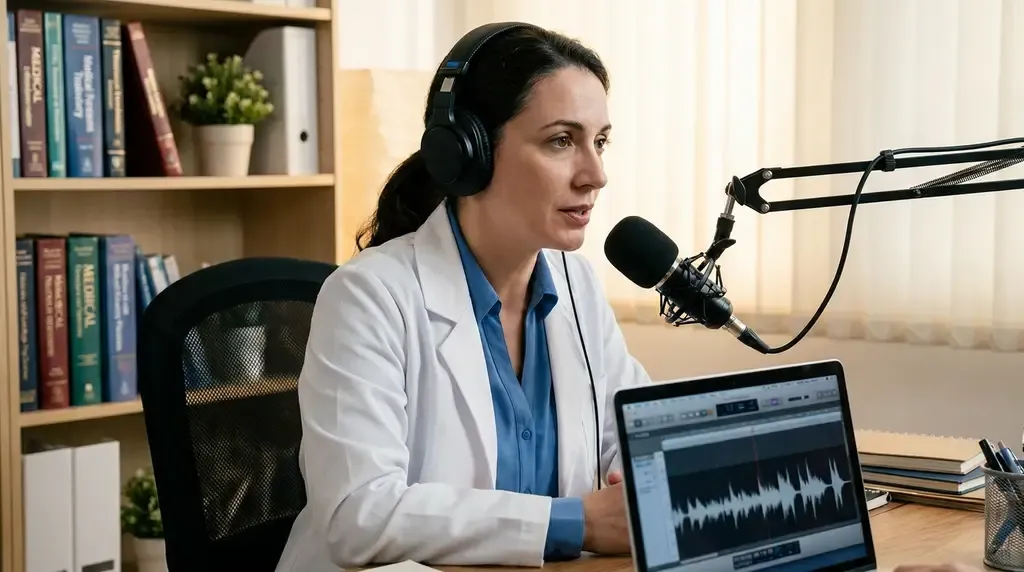
A podcast for doctors, planned around clinic hours: a 4-week launch plan in 7 steps, a 90-minute monthly recording routine, and topic ideas for physicians.
A podcast for doctors starts with something you already do every day: explaining a diagnosis, a treatment option, or a test result in words a patient can follow. Physicians who host a show take that skill out of the exam room and put it where patients, colleagues, and future referral partners can find it on their own schedule.
The obstacle for most doctors is time. Clinic days run long, charting follows you home, and the production work behind a show (editing, show notes, artwork, publishing) is a second job nobody trained you for. In our experience, the doctors who keep a show going for years have two things in place: a simple plan for what to record, and someone else handling the work after the recording.
This article gives you both. It covers who a physician podcast reaches, whether a show fits your practice, a seven-step launch plan you can finish in about four weeks, how much time the show takes each month, topic ideas by listener, and doctor podcast tips for the first 90 days. Our team has produced more than 5,000 episodes for experts and business owners, including physicians and other medical professionals, and this is the plan we use with them.
Who a podcast for doctors reaches
A show gives you a way to talk with three groups who rarely get more than a few minutes of your time: patients, referring colleagues, and the wider community around your practice. Our medical podcast page covers how we run a podcast for medical professionals in every specialty. The audience is large enough to justify the effort. Edison Research’s Infinite Dial 2026 survey reports these figures for the United States:
58%
of Americans aged 12 and older consumed a podcast in the last month, about 167 million people
68%
of 35 to 54-year-olds consumed a podcast in the last month
80%
of Americans aged 12 and older have ever listened to or watched a podcast, about 230 million people
Patients and the people who care for them
Patients often leave an appointment with more questions than they had time to ask. An episode that explains a condition, a procedure, or what recovery looks like gives them something to replay at home and share with family. New patients who hear you before they book arrive knowing how you explain things and how you work.
Referring physicians and colleagues
Doctors listen to podcasts too, and they are selective about it. When the American Medical Association asked physicians in its “Shadow Me” series to recommend podcasts, a family physician chose one because “it’s very practical, it’s evidence-based, and it’s time-efficient.” Another praised a “20-minute summary.” A physician podcast built to that standard gives colleagues a reason to know your work, and referring doctors send patients to specialists they know. Our list of chiropractic marketing ideas shows how a practice can build those referral relationships by interviewing local colleagues on the show.
Your practice and your professional profile
Every episode adds to a public record of how you think about your field. When a conference organizer or a local reporter needs a doctor who can explain a topic clearly, a back catalog of episodes shows that you can.
Should every doctor start a podcast?
No. It helps to know whether your practice is a good fit before you spend money. A podcast for doctors works when you have a clear listener, something to say every two weeks, and a way to tell people the show exists. The table below sorts the common situations we see on discovery calls.
| A podcast is a good fit if | Wait or plan more first if |
|---|---|
| Patients ask you the same questions every week | You cannot name who the show is for |
| You run a practice or service line that grows through referrals | You expect the show to replace all other marketing in month one |
| You already teach, speak, or write about your specialty | You have no patient list, newsletter, or network to share episodes with |
| You can set aside 90 minutes a month to record | Your schedule leaves no fixed time to record at all |
| You want a long-term way to explain your approach | You plan to stop after a handful of episodes |
Most doctors who reach us sit in the left column but have never had a plan for the right one. If you run a therapy or counseling practice, our therapist podcast page covers the formats and topics that suit that work.
How to start a podcast as a doctor in 7 steps
The plan below takes about four weeks. Weeks one and two are decisions only you can make. From week three, most of the work moves to your production team, and your part is recording. The graphic shows which week each step falls in and who owns it.
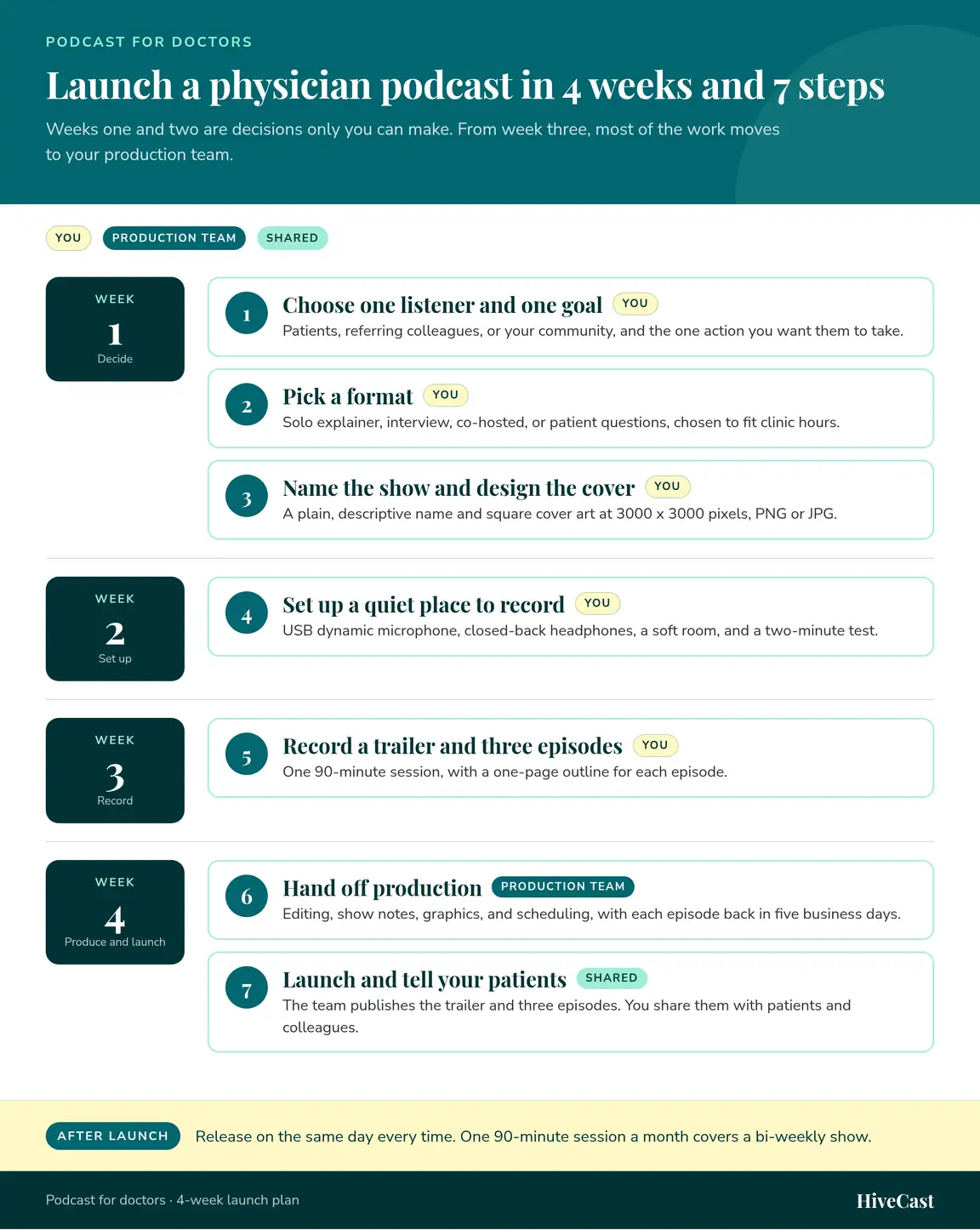
Step 1: Choose one listener and one goal (week 1)
Decide whether the show is for patients, for referring colleagues, or for your community, and write one sentence about what you want listeners to do after an episode. “Book a consultation for knee pain” and “refer complex cases to our clinic” lead to very different shows. A clear podcast strategy sets this goal first, because every later decision depends on it. Keep identifiable patient details out of every episode, and check your employer’s or practice’s policies on public speaking before you launch.
Step 2: Pick a format that fits your schedule (week 1)
The format decides how much preparation each episode needs and how simple it is to record around clinic hours.
| Format | Prep per episode | Best for | Watch out for |
|---|---|---|---|
| Solo explainer | A one-page outline | Patient education, one topic per episode | Sounding like a lecture |
| Interview | Guest research and booking | Referral relationships, colleague networks | Scheduling around two clinic calendars |
| Co-hosted | A shared outline | Practices with two partners or a care team | Hosts talking over each other |
| Patient questions | Collecting questions in advance | Answering what patients ask most | Questions that are too specific to one case |
Many doctors start with solo explainers and add an interview every third or fourth episode. Solo episodes are the simplest to record on short notice, and interviews with colleagues build the referral side of the show.
Step 3: Name the show and design the cover (week 1)
Use a name that tells a stranger what the show covers, such as your specialty and your audience, rather than a clever phrase. Then design the cover art. Apple’s Show Cover specs ask for a square image at 3000 x 3000 pixels, in PNG or JPG, with no transparency, and Apple accepts 1400 x 1400 to 3000 x 3000 through an RSS feed. Keep the title large and legible, because most people will see the cover at thumbnail size on a phone.
Step 4: Set up a quiet place to record (week 2)
You do not need a studio. A USB dynamic microphone, closed-back headphones, and a room with a rug, curtains, or a bookshelf will sound professional once the episode is edited. Your office after clinic hours often works well. For interviews, use a remote recording platform that records each person’s audio locally, and our guide to remote recordings covers the setup. Record a two-minute test and listen back on headphones before your first real session.
Step 5: Record a trailer and three episodes (week 3)
Record a one- to two-minute trailer that says who the show is for and what listeners will learn, then three full episodes. Launching with three episodes gives a new listener more than one reason to follow the show. Write a one-page outline for each: the question the episode answers, three or four main points, one example, and the action you want listeners to take.
💡 Record in one sitting
Book a single 90-minute block for your first session. A trailer and three 20-minute episodes fit in that time with setup and a short break, and recording back to back keeps your energy and sound consistent.
Step 6: Hand off production (week 4)
Production is the work that takes the most hours after recording. Every episode needs audio editing, written show notes that help search engines and listeners find it, promotional graphics, and scheduling to each directory. With done-for-you production, you record and send the file, and our team returns a finished episode in five business days.
Step 7: Launch and tell your patients (end of week 4)
Publish the trailer and all three episodes on launch day, then release on the same day each week or every other week. Tell the people who already know you: mention the show in your patient newsletter, add it to your website and email signature, put a sign with a QR code in the waiting room, and send the first episode to the colleagues who refer to you.
How much time a physician podcast takes each month
The time a show takes depends on who does the production. With done-for-you production, your part is recording plus a short monthly planning conversation and a quick review of each episode. The table shows how the rest of the work divides.
| Task | Who does it | When |
|---|---|---|
| Choosing topics and outlining | You, with your account manager | Once a month |
| Recording | You | One 90-minute session for a bi-weekly show |
| Editing and quality check | Our team | Within five business days |
| Show notes | Our team | With each episode |
| Two promotional graphics | Our team | With each episode |
| Scheduling to Apple Podcasts, Spotify, and all the major directories | Our team | On your release day |
| Reviewing the finished episode | You | A quick listen before release |
A bi-weekly show needs two episodes a month, and most of the doctors we work with record both in one session. A weekly show needs four, which usually means two sessions. If a busy month gets in the way, rollover lets you move 1 episode forward per month so a missed recording does not waste what you paid for.
Shows that keep this rhythm for years give patients and referring colleagues a steady way to find the practice. Dr. Andrew Fix of The Physio Room, host of The Code: A Guide to Health & Human Performance, told us:
“HiveCast’s expertise and guidance made it easy to turn our idea into a professional podcast. Over 200 episodes in, The Code has become one of our strongest sources of new clients and referral relationships in the health and performance community.”
Dr. Andrew Fix, The Physio Room
Physician podcast topic ideas by listener
The best topics come from the questions you already answer. Keep a running list on your phone for two weeks and you will likely have topics for several episodes. The table gives starting points for each of the three listeners from step 1.
| Listener | Episode ideas |
|---|---|
| Patients | What to expect before, during, and after a common procedure; how to prepare for a first appointment; myths about a condition you treat, explained plainly |
| Referring colleagues | When to refer and what to include in the referral; a case pattern you see often, described without patient details; a conversation with a colleague in a related specialty |
| Your community | Seasonal health questions; how to choose between treatment options; an interview with a local physical therapist, dietitian, or pharmacist |
You can also turn your most common patient questions into a short series. Five episodes on one condition, each under 20 minutes, give patients a set they can work through in order.
Doctor podcast tips for the first 90 days
The first three months set the habits that keep a show running. These are the points we go over with every physician who launches with us.
- Keep episodes to 20 or 30 minutes. Physicians quoted by the AMA singled out time-efficient shows, and patients listening on a commute have limited time too.
- Release on the same day every time. A fixed day makes the show simpler to follow and gives you a recording deadline.
- Answer one question per episode. Put the question in the episode title so people searching for it can find you.
- End every episode with one action. Tell listeners what to do next, such as booking an appointment, asking their own doctor a question, or reading the show notes.
- Collect questions at the front desk. A card or form in the waiting room gives you real topics and shows patients the show exists.
- Add video when you are ready. Some patients would rather watch than listen, and our video add-on turns each recording into a YouTube episode for $100 a month on the bi-weekly plan or $200 a month on the weekly plan. Our guide to healthcare video marketing shows the other formats one recording can become.
- Track inquiries, not only downloads. Ask new patients how they heard about you and count the ones who mention the show. That number tells you more about the show’s value to your practice than any download chart.
Getting your physician podcast on air around clinic hours
The first week of a podcast for doctors is yours to plan, and the weeks after it are mostly recording. Once you have chosen your listener and format, the next step is to book your first 90-minute session and decide who will produce the episodes.
Our podcast production service covers editing, show notes, two promotional graphics per episode, and scheduling to Apple Podcasts, Spotify, and all the major directories, with every episode turned around in five business days. We have helped launch 100’s of shows, and plans start at $500 a month for a bi-weekly show and $875 a month for a weekly show, with no long-term contracts. Our pricing page lists what each plan includes. Book a free discovery call and we will help you plan your first four weeks.
Frequently Asked Questions About Starting a Podcast for Doctors
Do doctors need special equipment to start a podcast?
No. A USB dynamic microphone, a pair of closed-back headphones, and a quiet room with soft furnishings are enough for a professional-sounding show. Many of our clients record in their office after clinic hours or in a spare room at home. For interviews, use a remote recording platform that records each person locally rather than a video-meeting app, because local recordings give the editor clean audio to work with.
How long should a physician podcast episode be?
Most of the doctors we work with settle on 20 to 30 minutes. That is long enough to explain one topic properly and short enough to fit a commute or a workout. When the AMA asked physicians to recommend podcasts, one praised a show for being time-efficient and another for its 20-minute format, so a tight episode is a strength. Interview episodes can run longer when the guest has more to say, as long as every segment earns its place in the edit.
I see patients all day. How much time will a podcast actually take?
With done-for-you production, your time is the recording itself plus a short review. A bi-weekly show needs two 30-minute episodes a month, which most doctors record in one 90-minute session, including setup and a short break. Editing, show notes, graphics, and publishing are handled by our team, and your dedicated account manager keeps the release schedule.
What does a podcast for doctors cost with HiveCast?
Our audio production plans are $500 a month for a bi-weekly show and $875 a month for a weekly show. Both include professional editing, SEO show notes, two promotional graphics per episode, and scheduling to Apple Podcasts, Spotify, and all the major directories. Video and YouTube editing is a paid add-on at $100 a month on the bi-weekly plan or $200 a month on the weekly plan. There are no long-term contracts.
Can I start a podcast as a doctor if I do not have an audience yet?
Yes, as long as you have a way to reach the people you want to serve. Your patient list, newsletter, practice website, and referral network are a starting audience, and they already trust you. A smaller audience in your own area or specialty is often worth more to a practice than a larger, general one. Plan to promote every episode to those groups for the first few months.
How fast can my first episode go live?
Most new shows we work with launch within one month. Once you send us your first recordings, every episode is produced and ready to publish in five business days. The four-week plan in this article is built around that timeline, with recording in week three and launch at the end of week four.
What happens on a free discovery call?
We ask about your specialty, the listeners you want to reach, how much time you have each month, and what a successful show would mean for your practice. Then we recommend a format, a release schedule, and the plan that fits. The call is free and there is no obligation.
Want this handled for you?
You record the episode, and HiveCast handles the editing, show notes, graphics, and scheduling. We have produced more than 5,000 episodes, and there are no long-term contracts.
More on Podcasting for Medical Professionals
Related Articles

How to Book Podcast Guests Who Show Up Ready to Record
Book podcast guests who fit your listeners and show up prepared, with a pitch email template and a follow-up and reminder plan for coaches and experts.
Business Podcast Promotion: 12 Tactics Ranked by Payoff
12 podcast promotion tactics for coaches and consultants, ranked by host time, cost and speed to results, so you can pick the three worth running first.

Professional Podcast Editing: 4 Options Before You Hire
Compare 4 professional podcast editing options, from DIY and AI tools to a freelancer or production team, plus 7 questions busy experts should ask first.