Business Podcast Promotion: 12 Tactics Ranked by Payoff

12 podcast promotion tactics for coaches and consultants, ranked by host time, cost and speed to results, so you can pick the three worth running first.
Podcast promotion is the part of running a show that most business owners plan to get to later. The episode goes out, there is a client deadline that week, and the only promotion it gets is one social post. Then the host reads a list of 50 promotion ideas, tries six of them for a month, and stops when none of them shows a clear result.
We have produced more than 5,000 episodes for coaches, consultants, authors, and experts, and the shows that grow do something simpler. They choose a few tactics that fit the host’s schedule, run them for every episode, and measure them against a business result such as booked calls. This guide ranks 12 tactics side by side on the time they take, what they cost, how quickly they work, and who they suit, so you can choose your three.
How we ranked these podcast promotion tactics
Every tactic below gets the same four ratings, because a tactic that suits a podcaster with a large social following can be a poor use of time for a consultant with a small, valuable email list. Rate your own options the same way before you commit to any of them.
- Host time per episode: the hours you personally spend, assuming editing and publishing are already handled.
- Cash cost: what you pay beyond your time.
- Time to impact: how long before the tactic sends listeners or leads.
- Best for: the kind of show or goal where the tactic earns its place.
| Tactic | Host time per episode | Cash cost | Time to impact | Best for |
|---|---|---|---|---|
| 1. Email your list on release day | 20 to 30 minutes | Your email software | Same week | Any show with a list |
| 2. Send episodes in sales conversations | 10 minutes | None | Same week | Consultants, coaches, B2B services |
| 3. Give every guest a share kit | 15 minutes | None | Same week | Interview shows |
| 4. Use one link per listening app | 5 minutes | None | Same week | Every show |
| 5. Write keyword-led titles and show notes | 45 minutes, or handed off | None | Three to six months | Shows that want search traffic |
| 6. Publish full episodes on YouTube | 1 to 2 hours, or handed off | Video editing if outsourced | Three to six months | Shows with a visual host or guests |
| 7. Re-promote your back catalog | 20 minutes a month | None | First month | Shows with 20 or more episodes |
| 8. Ask for ratings and reviews | 5 minutes | None | One to three months | Newer shows building credibility |
| 9. Trade promos with similar shows | 1 hour per trade | None | Same week as the promo airs | Shows with a defined niche |
| 10. Post short clips on one channel | 30 to 60 minutes, or handed off | Editing if outsourced | First month | Hosts already active on social |
| 11. Appear as a guest on other shows | 2 to 3 hours per appearance | None | One to three months | Experts building authority |
| 12. Pitch press and best-of lists | Several hours per campaign | None, or a publicist’s fee | Months, and uneven | Shows with a clear story or milestone |
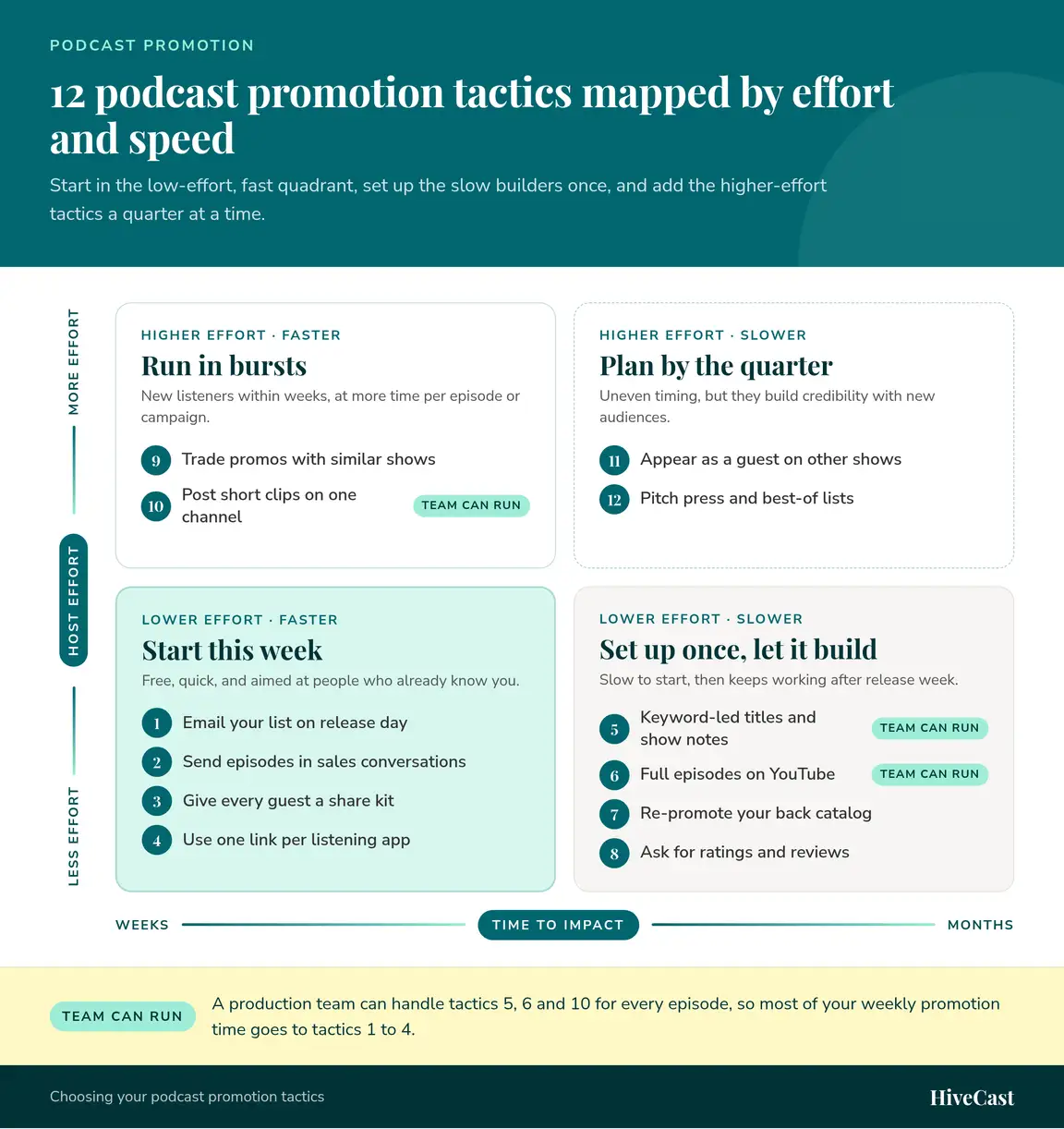
The table rates each tactic on its own. The map below groups the same 12 tactics by the two ratings that matter most for a busy host, effort and speed, and marks the ones a production team can run for you.
Quick wins to start this week
These four tactics need little time, cost nothing, and reach people who already have a reason to listen. If you only adopt one group from this guide, start here. When we review a show that has stalled, these are usually the steps that dropped out first.
1. Email your list on release day
Your email list is the audience most likely to press play, because those readers asked to hear from you. Send a short note on release day with one sentence on the problem the episode solves, one takeaway, and a single link. Avoid sending the whole show notes, because a long email gets skimmed and the link gets missed.
Your email list is the audience most likely to press play, because those readers asked to hear from you.
If you publish bi-weekly, the episode email can replace your regular newsletter on release weeks, so promotion does not add a second email to your calendar.
2. Send episodes in sales conversations
This is the tactic business hosts overlook most. When a prospect asks a question you have already answered on the show, send them that episode before or after the call. It gives the prospect 30 minutes with you on their own time, and they often arrive at the next conversation already familiar with how you work.
Keep a simple list of your episodes sorted by the questions prospects ask most. Your sales follow-up template, your email signature, and your booking confirmation page are all places where one relevant episode link fits naturally.
3. Give every guest a share kit
Guests are willing to share, but most will not write a post from scratch. Send them a kit a few days before release: the episode link, a graphic with their photo, a short clip, and two suggested posts they can edit. Interview shows that do this get a new audience with every episode at no cost.
Our podcast marketing plan lists what belongs in a guest share kit and how to fit it into your weekly routine.
4. Use one link per listening app
Every link you share should open the episode in the listener’s preferred app with as few taps as possible. Apple’s free marketing tools give you badges, embedded players, and QR codes, plus Linkfire landing pages that show which campaigns send the most listeners. A QR code on a slide or a printed handout works well for hosts who speak at events.
If most of your audience listens on Apple Podcasts, our guide to Apple Podcasts deep links shows how to send people straight to the follow button.
💡 Good to know
Apple’s free marketing tools include badges, embedded players, and QR codes. A QR code works well on a slide or a printed handout if you speak at events.
Set-up-once tactics that build over months
These four tactics are slow to show results, but each one keeps working after release week. They also share an advantage for busy hosts: the work can be built into production, so it happens for every episode without extra effort from you.
5. Write keyword-led titles and show notes
People search inside podcast apps, on Google, and on YouTube using the words of their problem, not the name of your show. An episode titled “Episode 52 with Jane Smith” matches nothing, while “How to price a coaching package, with Jane Smith” matches a real search. Write show notes around one keyword per episode, with a short summary, the guest’s details, and your call to action.
Search traffic builds slowly because older episodes need time to collect visits, which is why we put this tactic in the set-up-once group. Our podcast SEO service covers this work, starting with the show title, subtitle, and description, which carry the most weight in the apps. If you would rather do it yourself, our SEO playbook sets out the work week by week.
6. Publish full episodes on YouTube
Many people now look for podcasts on YouTube first. Edison Research’s 2025 top findings report that 52% of Americans aged 12 and older consider YouTube-only discussion videos to be podcasts, so a show that is missing from YouTube is missing from where many listeners start.
YouTube’s own discovery tips are short: create a public podcast in YouTube Studio for each show, use the same name as your podcast, and add a detailed description. Our walkthrough of YouTube podcast setup covers the rest, including whether to publish a full video version or an audio upload with your show art.
7. Re-promote your back catalog
Your strongest episode from last year is new to everyone who found the show this month. Once a month, pick an older episode that answers a question prospects are asking now and send it to your list or share it on your main channel. It takes about 20 minutes and gives you promotion material on weeks when you do not have a new release.
A curated set of best episodes does the same job for first-time visitors. A starter playlist on your website and in your show description tells a new listener which three or four episodes to play first.
8. Ask for ratings and reviews
Ratings help a new visitor decide whether a show is worth their time. Ask in your outro and in your episode emails, and make the request specific: one tap on the stars, plus a sentence about the episode that helped most. Timing matters, and our guide to getting more podcast reviews covers when the request works best.
Higher-effort tactics with a fast payoff
These two tactics take more time per episode or per campaign than the quick wins, but they can reach new listeners within weeks. Run them in bursts rather than every week if your schedule is tight.
9. Trade promos with similar shows
A promo trade is an agreement with another podcast in a related niche: each host records a short spot recommending the other show and plays it in an upcoming episode. Both audiences already listen to podcasts on the topic, which makes them the easiest new listeners to win. A coach who hosts a leadership show might trade with a show on hiring or with an HR consultant’s podcast.
Keep the spot to about 30 seconds, read it in your own voice rather than a script that sounds like an ad, and place it at the start or middle of the episode, where more listeners hear it. If the other host is paying you or you are paying them, disclose the arrangement to listeners.
🔴 Disclose paid trades
If money changes hands in a promo trade, tell your listeners about the arrangement. Keep the spot short and read it in your own voice, not a script.
10. Post short clips on one channel
A 30 to 60 second clip with captions gives people a sample of the show without asking them to commit to a full episode. Edison Research’s same 2025 findings report that 47% of weekly TikTok users aged 13 and older use TikTok to discover podcasts. LinkedIn is the better choice for most B2B hosts, so pick the one channel where your clients spend time and post there consistently.
Spotify also lets you attach a short clip to each episode. Clips run 15 to 90 seconds, you can upload one per episode, and Spotify may recommend them in its Home and Podcast feeds. If you want clips to bring in leads rather than views, our piece on turning podcast clips into leads shows how to connect a clip to a free resource.
Long-game tactics that reach new audiences
The last two tactics take the most effort and pay off on the most uneven schedule, but they build the kind of credibility that a business show needs. Plan them by the quarter.
11. Appear as a guest on other shows
Guesting puts you in front of an audience that already trusts the host who invited you. Choose shows your clients listen to rather than the biggest shows that will reply, and pitch one specific topic you can speak on with stories from your own work. Mention your podcast once, near the end, with an episode that follows on from the conversation.
Two or three appearances a quarter is a realistic pace for most business owners. Each one also gives you a relationship with a host who may later want a promo trade or an interview on your own show.
12. Pitch press and best-of lists
Coverage in a trade publication, a newsletter, or a year-end list of recommended shows brings credibility and a burst of new listeners. It also takes the most effort for the least predictable return, because the decision sits with an editor. Our guide to podcast PR explains how to pitch with a clear angle and a press kit, so you do not spend hours on cold emails.
Podcast promotion tactics to skip or test later
Some tactics show up on every list of promotion ideas but rarely help a business show in its first year. These are the ones we suggest you hold back.
- Paid podcast ads. Ads can bring in listeners, but the flow stops when the budget does. Test them later with a small budget, send them to one strong episode, and measure email signups or booked calls.
- Bought downloads or follows. Services that sell plays inflate your numbers without adding anyone who will become a client, and they make your real data harder to read.
- Follow-for-follow and review-swap groups. These produce ratings from people who never listen, so they tell real visitors nothing about the show.
- Posting on every social platform at once. Occasional posts on six channels reach fewer of the right people than steady posts on one.
How do you build a podcast promotion strategy from this list?
Choose three tactics: two from the quick-win group and one set-up-once tactic. Most business hosts pick the release-day email, sales conversations, and keyword-led titles and show notes, because those three cover people who know you, people about to buy from you, and people searching for your topic. Run them for every episode for one quarter before adding anything else.
Then measure the three against the business result you care about. A question on your booking form asking how prospects heard about you will tell you more than a download chart. If you want help choosing the result and the metrics, our podcast marketing services start with that conversation, and the marketing plan guide linked above walks through the full process week by week.
When the first three are routine, add one tactic from the higher-effort groups each quarter. Guest appearances and promo trades usually come next, since each one introduces the show to a new, already-interested audience.
Choosing your first three podcast promotion tactics
Knowing how to promote a podcast comes down to choosing a few tactics you will keep running. Start with the people who already know you, set up the search-based work once so it builds in the background, and add relationship tactics such as guesting and promo trades a quarter at a time. Judge every tactic by the calls and signups it brings in.
Our team handles the production side of podcast promotion for coaches, consultants, authors, and medical professionals every week, from titles and show notes to graphics and publishing, with no long-term contracts. Book a free discovery call and we will help you pick the three tactics that suit your show and your calendar.
Frequently Asked Questions About Podcast Promotion
What is the most effective way to promote a podcast?
For a business show, the most effective tactic is usually the simplest one: sending each new episode to your own email list on release day. Those readers already know you, so they listen and reply at a far higher rate than strangers on social media. Pair that with keyword-led titles and show notes so new people can find older episodes through search, and you have covered both short-term and long-term reach.
How do I promote my podcast for free?
Most of the tactics in this guide cost nothing but time: emailing your list, sending relevant episodes to prospects, giving guests a share kit, using Apple's free marketing tools for links and QR codes, asking for ratings, trading promos with similar shows, and appearing as a guest on other podcasts. Paid ads are the only tactic on our list that needs a budget, and we suggest holding off on them until your free channels are running every episode.
How long does podcast promotion take to show results?
It depends on the tactic. An email to your list or a promo trade with another show can bring listeners in the same week. Search-based tactics such as titles, show notes, and YouTube usually take three to six months, because older episodes need time to collect visits. Give any combination of tactics at least one full quarter before you decide whether it is working.
Should I pay for podcast ads to grow my show?
Not at first. Paid ads stop sending listeners the day the budget runs out, and a new business show usually gets more from its email list, guests, and search-friendly episodes. Once those run every episode, a small test can make sense if you send it to one strong episode and measure email signups or booked calls rather than downloads.
How much time per week does podcast promotion take?
With production handed off, the tactics in our quick-win group take about an hour per episode: writing the release email, sending the episode to a few prospects, and posting once on your main channel. Guest appearances and promo trades add time in bursts, mostly for outreach and recording, so schedule them a few times a quarter rather than every week.
Which promotion tasks does HiveCast handle for me?
We write keyword-focused titles and SEO show notes, design two promotional graphics per episode, and schedule every episode to Apple Podcasts, Spotify and all the major directories within a five-business-day turnaround. The video add-on covers the YouTube version, and the Enhanced Marketing add-on adds three cutdowns per episode posted as YouTube Shorts. We do not run paid ads or PR outreach, and the relationship tactics such as guest appearances and promo trades stay with you.
What happens on a free discovery call?
We ask about your business, the clients you want the show to reach, and how much time you have each week. Then we suggest which promotion tactics fit your schedule and which parts of the work our team can take over. The call is free, and our plans have no long-term contracts if you decide to work with us.
Want this handled for you?
You record the episode, and HiveCast handles the editing, show notes, graphics, and scheduling. We have produced more than 5,000 episodes, and there are no long-term contracts.
More on Podcast SEO
Related Articles

Podcast SEO: How to Get Your Show Found in Search
Podcast SEO works in two places: the search inside Apple and Spotify, and the episode pages Google reads. Here is what to fix in each, and in what order.

Search Console Now Links Your Social: What It Means
Learn what Google Search Console for YouTube means for podcasters, what data it shows, and how to use it to improve discoverability.
5 Tips to Rank Higher on Apple Podcasts in 2026
Rank higher on Apple Podcasts in 2026: optimize metadata, earn more follows, improve retention, and turn Search and Top Charts into discovery.