Podcast Marketing Plan for Business Owners: 6 Steps and a 90-Day Calendar

A podcast marketing plan for coaches and consultants: 6 steps, a week-by-week 90-day calendar, a per-episode checklist, and real time and cost figures.
Most business owners who start a show put their effort into the recording and treat podcast marketing as something to figure out after launch. By then the episodes are going out to a small audience, the host is busy with client work, and promotion happens only when there is a spare hour. The episodes still go out on schedule, but few of them lead to a sales call or a referral.
We have produced more than 5,000 episodes for coaches, consultants, authors, and experts. The shows among them that bring in clients usually follow a short written plan that names one business result, sets up the show so buyers can find it, commits to a few channels, and repeats the same routine for every episode. The plan also splits the work between the host and whoever handles production, so it still gets done in a month when client work is heavy.
This guide gives you that plan in six steps, with a 90-day calendar, a promotion checklist for every episode, a share kit for guests, a scorecard, and the time and money each approach costs.
What a podcast marketing plan covers
A podcast marketing plan is a written list of what you will do to get each episode in front of the right people, who does it, and how you will know it is working. For a business show, the right people are prospects, referral partners, and peers, so the plan is built around them rather than around a download target. We cover the same ground in our podcast strategy kickoffs, and it breaks into four layers.
| Layer | What it includes | Who usually owns it |
|---|---|---|
| Findability | Show title, description, category, episode titles, show notes, episode pages on your site | Production team |
| Distribution | Directories, YouTube, your email list, social channels | Shared |
| Relationships | Guests, guest appearances on other shows, referral partners | Host |
| Conversion | The call to action in each episode and the page it sends people to | Host, with production support |
Most shows put all their effort into distribution and skip the other three layers. In our experience, whether buyers can find the show and whether each episode ends with a clear call to action affect how many clients it brings in more than audience size does.
Edison Research’s Infinite Dial 2026 study found record podcast listening in the United States this year:
58%
of Americans aged 12 and older, about 167 million people, consumed a podcast in the last month
68%
of 35 to 54-year-olds, where many business owners and decision-makers sit, did the same
57%
of Americans aged 12 and older have both listened to and watched a podcast
The last figure matters for planning because many of the same people both listen to and watch podcasts. If you publish a video version of each episode alongside the audio, you can reach more of your buyers from the same recording.
The 6-step podcast marketing plan
The six steps run in order, and each one produces something the next step needs. Steps 1, 3, and 6 need the host’s judgment, while steps 2, 4, and 5 are repeat work that a production team can run for you every week.
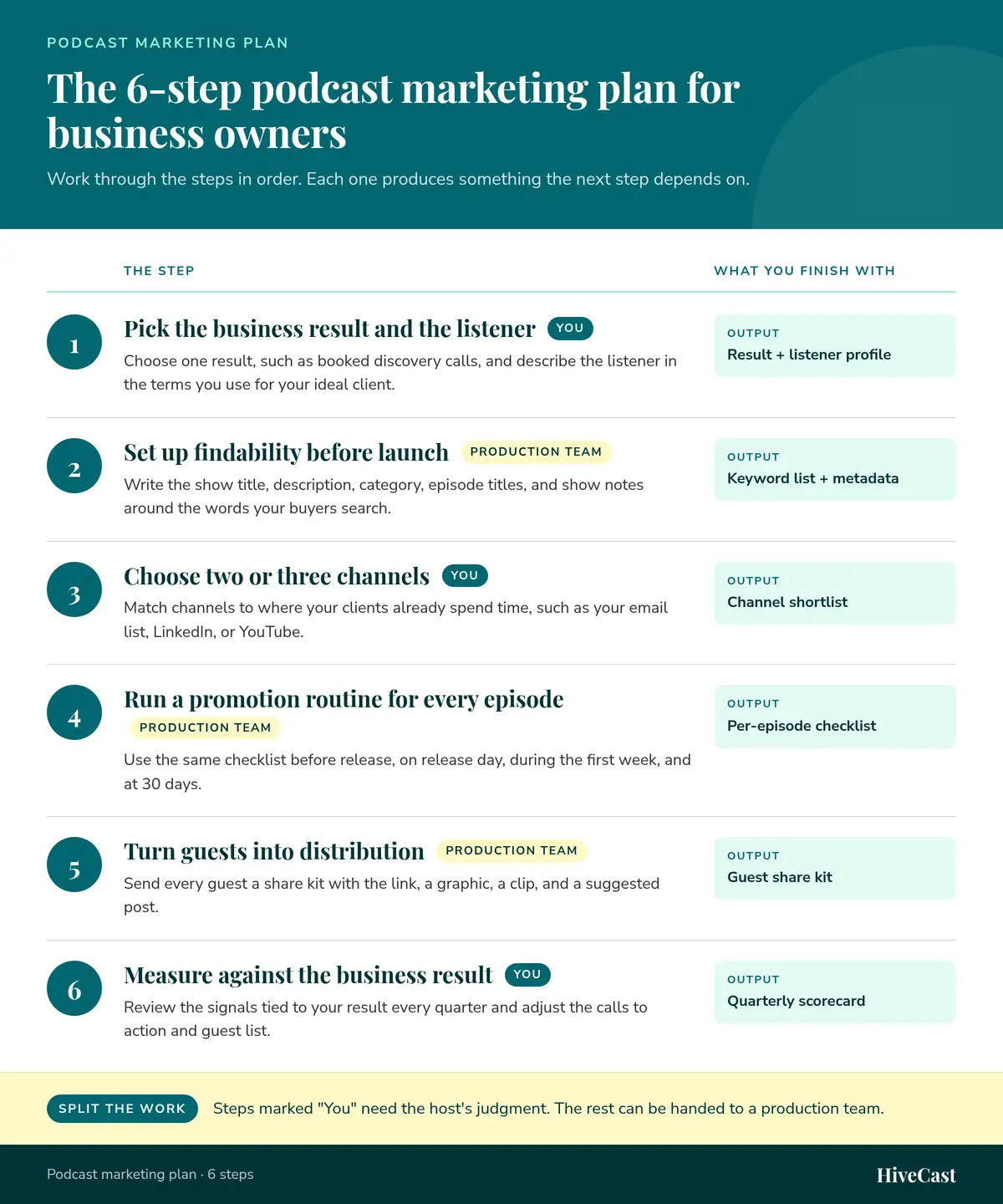
Step 1: Pick the business result and the listener
Start by deciding what the show is for, because that result determines which channels and metrics matter. Choose one primary result from the table below, then describe the listener in the terms you use for your ideal client: their role, the problem they want solved, and the words they would type into a search bar.
| Business result | Main signal to track | Channels that usually fit |
|---|---|---|
| Booked discovery calls | Prospects who mention the show on a call | Email list, LinkedIn, website episode pages |
| A larger email list | Signups from the episode call to action | Show notes, YouTube, social clips |
| Referral relationships | Guests and peers who send introductions | Guest invitations, guest appearances on other shows |
| Credibility before a launch | Speaking and press invitations | Guest appearances, podcast PR, YouTube |
Write one call to action that serves the result, such as a free assessment or a link to book a call, and use it at the end of every episode for at least a quarter. When the request is the same each time, listeners remember it and are more likely to act on it.
💡 Stay consistent
Point the call to action at the same page in every episode, so you can count how many people respond to it over the quarter.
Step 2: Set up findability before launch
Findability is the work that lets people discover the show through search, inside podcast apps and on Google and YouTube. This work keeps paying off after release day, because an episode with a clear, searchable title can keep finding new listeners for years. Our podcast SEO service covers this layer, and the checklist below is where to start.
- Show title and description. Include the topic your buyers search for, not only the show’s brand name. Apple lists the title, description, artwork, and category among the details every show must supply in its podcast requirements, so write them with your buyers in mind, the same way you would write a sales page.
- Category. Pick the category your listeners browse, such as Business or Health & Fitness, rather than the broadest one available.
- Episode titles. Lead with the topic or question, then the guest’s name if it helps. Our advice on writing episode titles covers the title patterns that get more clicks.
- Show notes. Write a summary built around one keyword per episode, with timestamps and the call to action. Well-written show notes also give each episode a page Google can index.
- Episode pages on your website. Publish each episode on your own site so search visits land where your call to action lives.
💡 Title order
Lead with the topic or question in your episode title, then add the guest’s name if it helps. People rarely search for a guest’s name on its own, so a title that contains only the name is hard to find.
Step 3: Choose two or three channels
Every channel takes time each week, so you will usually get more from two channels you post on consistently than from eight you post on when you have a spare hour. Choose from the matrix below based on where your clients already spend time and how quickly you need results.
Choose channels by where your clients already spend time, and post on them every week.
| Channel | Best for | Time per episode | When results show |
|---|---|---|---|
| Email list | Booked calls, repeat listening | 20 to 30 minutes | First week |
| B2B buyers, consultants, coaches | 30 minutes | First month | |
| Guest appearances on other shows | New audiences, authority | 1 to 2 hours per appearance | One to three months |
| YouTube | Search, video-first listeners | 1 to 2 hours, or handed off | Three to six months |
| Website episode pages | Google search | 30 minutes, or handed off | Three to six months |
| Paid ads | Testing one strong episode | Budget plus setup time | Immediate but temporary |
If your clients are business buyers, the email list and LinkedIn are usually the first two picks. If you want the show found by people who do not know you yet, add YouTube, which can publish an audio show from its RSS feed by turning each episode into a video with your show art, according to YouTube’s help center. A full video version reaches more people, and our piece on growing a podcast on YouTube explains the difference.
Step 4: Run a promotion routine for every episode
Following the same checklist for every episode means promotion still happens in weeks when you have little time to plan it. Use these four checkpoints for each release.
Before release
- Final title and show notes written around one keyword
- Two promotional graphics ready
- Guest share kit sent
Release day
- Episode live on all directories and your website
- Email sent to your list
- First post on your main channel
Days 2 to 7
- Second post with a short clip or quote
- Reply to every comment and message
- Share the episode with one prospect it would help
Day 30
- Check which channel sent the most listeners
- Note any sales calls or signups that mention it
- Link it from a newer episode on a related topic
The clip step is where many hosts get stuck, because cutting video takes time. Short podcast clips are worth the effort when each one points to a single next step, such as a free resource or a booking link.
Step 5: Turn guests into distribution
Every guest has an audience, and most guests are happy to share an episode if you make it easy. Send a share kit a few days before release so the guest can post on the same day you do.
| Share kit item | Why it helps |
|---|---|
| Episode link and release date | The guest can schedule their post in advance |
| One promotional graphic with their photo | Guests are more likely to share a graphic that features them |
| A 30 to 60 second clip | Gives the guest something native to post on LinkedIn or Instagram |
| Two suggested posts they can edit | Removes the writing work, which is the main reason guests do not share |
| A thank-you note with the episode’s key point | Keeps the relationship going after the recording |
Guests also belong to the relationship layer from the table at the top of this guide. If you choose guests from the list of people you want to know, such as prospective clients and referral partners, each episode also opens a business conversation. When you appear as a guest on other shows, you reach their audience in the same way, and a structured approach to podcast PR helps you land those appearances.
Step 6: Measure against the business result
Downloads show how many people the show reaches, but they will not tell you whether it is producing the business result you picked in step 1. Review the scorecard below every quarter, because a business podcast builds results over months rather than weeks.
| Metric | Where to find it | Review |
|---|---|---|
| Prospects who mention the show | A “How did you hear about us?” question on your booking form | Quarterly |
| Email signups from the call to action | Your email platform, using a dedicated link | Monthly |
| Guests who become clients or referrers | A simple guest list with notes | Quarterly |
| Search visits to episode pages | Website analytics | Quarterly |
| Ratings and reviews | Apple Podcasts and Spotify | Quarterly |
Ratings help new listeners decide whether to try the show, and you will get more of them if you ask at the right moment. Our guide to getting more podcast reviews covers when and how to ask.
🔴 If results stall
If the scorecard stays flat for two quarters, look at your call to action and your guest list first. In our experience, those are the two parts of the plan that most often need changing.
A 90-day podcast marketing calendar
The calendar below puts the six steps on a schedule. It assumes you keep recording and publishing on your normal cadence, and gives you one marketing focus per week on top of that.
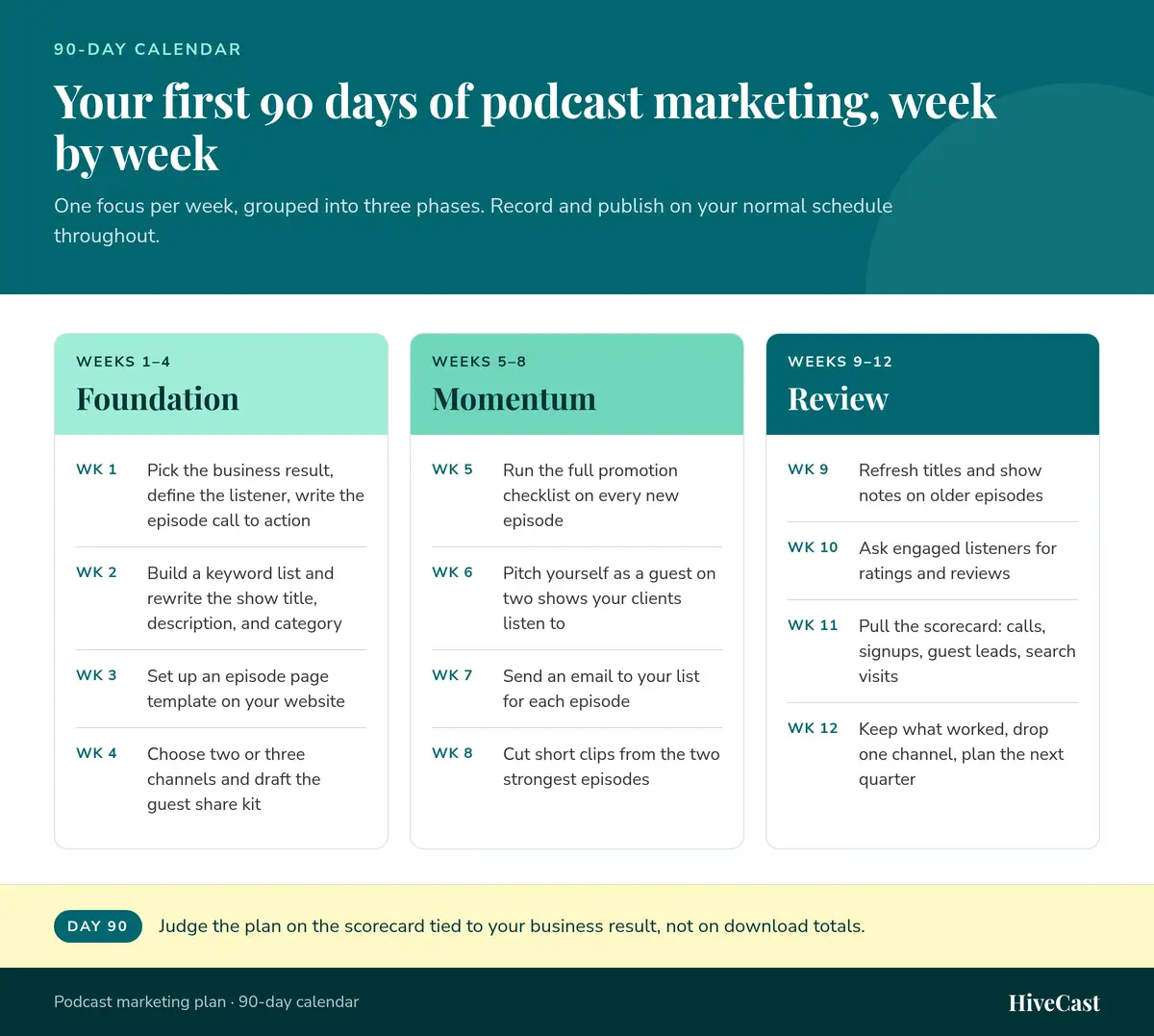
| Week | Focus | Done when |
|---|---|---|
| 1 | Pick the business result, define the listener, write the call to action | The call to action is recorded into your next episode |
| 2 | Build a keyword list, rewrite the show title, description, and category | The new metadata is live in every directory |
| 3 | Set up an episode page template on your website | The latest episode has its own page with show notes |
| 4 | Choose two or three channels, draft the guest share kit | The kit is ready to send to your next guest |
| 5 | Run the full promotion checklist on every new episode | All four checkpoints are ticked for the week’s episode |
| 6 | Pitch yourself as a guest on two shows your clients listen to | Two pitches are sent |
| 7 | Send an email to your list for each episode | The email is part of release day |
| 8 | Cut short clips from your two strongest episodes | Clips are posted with a link to the full episode |
| 9 | Refresh titles and show notes on older episodes | Your ten most-played episodes have keyword-focused titles |
| 10 | Ask engaged listeners for ratings and reviews | The request is in your episode outro and your email |
| 11 | Pull the scorecard | Every metric in the step 6 table has a number |
| 12 | Keep what worked, drop one channel, plan the next quarter | The next 90-day focus list is written |
After day 90, repeat weeks 5 to 12 on the channels that produced results. Most hosts find the second quarter easier, because the routine is set and the archive has started to bring in search traffic.
How much time and money podcast marketing takes
Most of the cost of podcast marketing is the host’s time, and it adds up because the work repeats with every episode. Production and promotion together can take several hours per episode, and many shows stop publishing regularly once client work picks up. You can do the work yourself, hire freelancers, or hand it to a done-for-you team.
| Do it yourself | Freelancers | Done-for-you team | |
|---|---|---|---|
| Host time per episode | 4 to 8 hours | 1 to 2 hours, plus managing people | About 1 hour |
| Cash cost | Software only | Per task, rising with each channel | One monthly fee |
| Consistency | Drops when you get busy | Depends on each freelancer | Set by the team’s schedule |
| Who keeps it on track | You | You | A dedicated account manager |
Our podcast production service is the done-for-you option. You record and send the file, and our team handles editing, keyword-focused titles and SEO show notes, two promotional graphics per episode, and scheduling to Apple Podcasts, Spotify, and the major directories, with a five business day turnaround. The bi-weekly plan is $500 a month and the weekly plan is $875 a month, with no long-term contracts. New shows pay a one-time $495 setup fee. The Enhanced Marketing add-on adds three audio or video cutdowns per episode, posted as YouTube Shorts, for $100 or $200 a month. Full details are on our pricing page.
Podcast marketing mistakes that stall a show
These are the problems we see most often when a host brings us a show that has stopped growing. Each one maps to a step in the plan.
- Measuring downloads instead of the business result. A show with modest downloads can still fill a consultant’s calendar. Track the signal from step 1.
- Changing the call to action every episode. Listeners are more likely to act on a request they have heard several times, so keep one call to action for at least a quarter.
- Brand-only titles. A title like “Episode 47 with Jane Smith” contains no words a buyer would search for, so put the topic first.
- Too many channels. Spreading your time across six platforms usually means posting irregularly on all of them, and two platforms you post on every week will do more for the show.
- Forgetting the back catalog. Older episodes can bring in listeners for years if their titles and show notes are updated.
- Stopping after a few months. A bi-weekly show that keeps publishing for years builds a larger archive and audience than a weekly show that stops after four months, so choose a cadence you can keep up.
What is the best way to market a podcast?
The best way to market a podcast for a business is to promote each episode to people who already know you, through your email list and your main social channel, while setting up titles and show notes so new people can find the show through search. Guest sharing adds a new audience with every episode at little cost. Paid ads and large social campaigns come later, once you know which episodes and calls to action convert.
If your show publishes regularly but is not bringing in clients, the plan itself usually needs work, starting with the business result, the listener, and the call to action. Our podcast coaching program, the six-week Business Results Accelerator with founder Sarah Walling Lockwood, works through those three areas with hosts in that position.
Putting your podcast marketing plan to work
To put this plan to work, write down the business result you want and the listener you are trying to reach, update your show’s titles and show notes so buyers can find it, and choose two or three channels you can post on every week. Use the same promotion checklist for each episode, review the scorecard each quarter, and change one thing at a time, starting with the call to action and the guest list.
Our team runs the production side of this plan for coaches, consultants, authors, and medical professionals every week, so you can spend your time recording and talking to the people the show brings in. Book a free discovery call and we will help you choose the result, the channels, and the plan that suits your schedule.
Frequently Asked Questions About Building a Podcast Marketing Plan
How much does podcast marketing cost for a small business?
If you do it yourself, the main cost is time: a full promotion routine takes two to four hours per episode on top of production. Freelancers typically charge per task, so costs rise with every channel you add. Our plans are $500 a month for an episode every other week and $875 a month for a weekly episode, and they include editing, SEO show notes, two promotional graphics per episode, and directory scheduling. New shows pay a one-time $495 setup fee, and the Enhanced Marketing add-on, which adds three short cutdowns per episode, is $100 or $200 a month.
How much of my own time does this plan need each week?
With production handed off, most hosts spend about an hour a week on marketing: sending the episode email, posting on one or two channels, and following up with guests. The steps that need your judgment are choosing the business result, picking channels, and reviewing the scorecard each quarter. Everything else in the plan can be handled by a production team.
How long does it take to see results from podcast marketing?
Give the plan at least 90 days before judging it, and six months before making big changes. Guest relationships and prospects who mention the show usually appear first. Search traffic to episode pages builds more slowly, because older episodes keep collecting visits as the archive grows.
Should I pay for podcast ads to grow my show?
For most business podcasts, paid ads are a later step. Ads can bring in listeners, but a small show gets more from its own email list, guest sharing, and search-friendly titles and show notes first. If you test ads, send them to one strong episode and measure the result you care about, such as email signups, rather than downloads.
Which parts of the plan does HiveCast handle, and which stay with me?
You record, choose the business result, and show up on your chosen channels. We handle editing, keyword-focused titles and SEO show notes, two promotional graphics per episode, and scheduling to Apple Podcasts, Spotify, and the major directories, with a five business day turnaround. The Enhanced Marketing add-on adds three cutdowns per episode posted as YouTube Shorts, and a dedicated account manager keeps the schedule on track.
What happens on a free discovery call?
We ask about your business, the clients you want to reach, and how much time you have each week. Then we recommend a format, a publishing cadence, and the plan that fits. The call is free, and there are no long-term contracts if you decide to work with us.
Want this handled for you?
You record the episode, and HiveCast handles the editing, show notes, graphics, and scheduling. We have produced more than 5,000 episodes, and there are no long-term contracts.
More on Podcast SEO
Related Articles

Business Podcast Promotion: 12 Tactics Ranked by Payoff
12 podcast promotion tactics for coaches and consultants, ranked by host time, cost and speed to results, so you can pick the three worth running first.

Podcast SEO: How to Get Your Show Found in Search
Podcast SEO works in two places: the search inside Apple and Spotify, and the episode pages Google reads. Here is what to fix in each, and in what order.

Search Console Now Links Your Social: What It Means
Learn what Google Search Console for YouTube means for podcasters, what data it shows, and how to use it to improve discoverability.